Directions: A cube of side 10 cm is coloured red with a 2 cm wide green strip…
2025
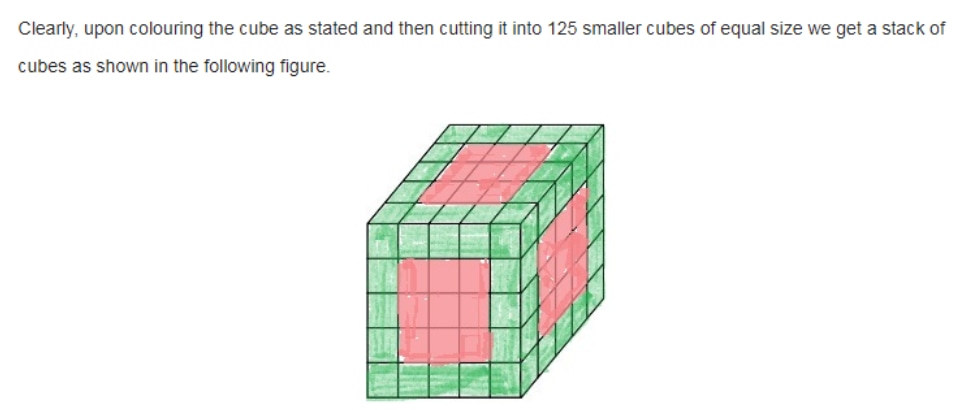
Directions: A cube of side 10 cm is coloured red with a 2 cm wide green strip along all the sides on all the faces. The cube is cut into 125 smaller cubes of equal size. Answer the following questions based on this statement: How many cubes have three green faces each?
Answer: C. 8 — Concept: When a cube is cut into an n × n × n grid of equal smaller cubes, the number of the outer surface's faces each small cube exposes depends only on…
- A.
7
- B.
6
- C.
8
- D.
9
Attempted by 8 students.
Show answer & explanation
Correct answer: C
Concept: When a cube is cut into an n × n × n grid of equal smaller cubes, the number of the outer surface's faces each small cube exposes depends only on where it sits: a cube at a corner of the grid exposes 3 outer faces, a cube along an edge (but not at a corner) exposes 2, a cube at the centre of a face exposes 1, and any fully interior cube exposes none — this positional rule holds for any n ≥ 2. Whether those exposed faces are specifically green (rather than red) then depends on how the colour band lines up with the cut lines: when the coloured strip's width is a whole multiple of the small-cube edge (as it is here), the strip covers complete rows of small cubes along every edge of every face, so a small cube's exposed face is either wholly inside the strip (green) or wholly outside it (red) — with no partially-coloured faces to worry about. Since the strip runs along every edge of every face, the strip band on any face always includes that face's four corner cells, so a corner small cube — which by the positional rule always exposes exactly three faces — has all three of them landing inside the green strip.
Applying to this cube:
125 small cubes means the cube is cut into a 5 × 5 × 5 grid (since 53 = 125), so each small cube has an edge of 10 cm ÷ 5 = 2 cm.
The green strip is stated to be 2 cm wide, which is exactly one small-cube edge — so on every face, the green strip is precisely the outermost ring of small squares, and the interior 3 × 3 patch of that face is red, as the figure shows.
The four corners of any face always lie inside that outermost ring, so a small cube sitting at a corner of the big cube shows green on all three of its exposed faces.
Only the corner positions of the big cube touch three outer faces at once, and a cube — whatever grid it is diced into — always has exactly 8 corners.
Cross-check: with the standard position count for an n × n × n cut (n = 5): corner cubes = 8 (fixed, any n), edge-only cubes = 12(n − 2) = 36, face-centre cubes = 6(n − 2)2 = 54, and fully interior cubes = (n − 2)3 = 27. These add to 8 + 36 + 54 + 27 = 125, matching the total given in the question, confirming the corner count independently of the colour-band reasoning above.
Answer: The number of small cubes with three green faces each is 8.