Choose the box that is similar to the box formed from the given sheet of paper…
2024
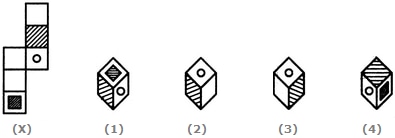
Choose the box that is similar to the box formed from the given sheet of paper (X).
- A.
1 and 2 only
- B.
1, 2 and 4 only
- C.
1 and 4 only
- D.
1, 2 and 3 only
Attempted by 1 students.
Show answer & explanation
Correct answer: B
When a flat six-square net is folded into a cube, the six faces pair up into exactly three pairs of OPPOSITE faces. Two rules govern this: (1) whenever three squares in the net form a straight, unbroken line, the first and third square always fold to become opposite faces (the middle one becomes adjacent to both); and (2) even a set of three mutually adjacent faces that passes the opposite-face check can still be assembled in two mirror-image ways around their shared corner -- a real cube can be rotated into any view, but never turned into its mirror reflection, so only ONE of those two arrangements is actually reachable from a given net.
Label sheet X's six faces in the order they run down the net: a blank face (top), a diagonally hatched face, a face with a circle, a blank face (left of the circle), another blank face, and a small shaded/checkered face -- call them Blank-1, Hatch, Circle, Blank-2, Blank-3, Shaded, in the order they appear along the net.
Blank-1, Hatch and Circle form a straight run of three squares in the net, so Blank-1 and Circle fold to become OPPOSITE faces (rule 1).
Blank-2, Blank-3 and Shaded also form a straight run of three squares, so Blank-2 and Shaded fold to become OPPOSITE faces (rule 1).
That accounts for two of the three opposite pairs; since all six faces must pair up, the only faces left -- Hatch and Blank-3 -- must be the third opposite pair, by elimination.
So the three opposite pairs are: {Blank-1, Circle}, {Blank-2, Shaded}, {Hatch, Blank-3}. Equivalently, the circle, shaded and hatched faces are each opposite a different blank face, and are therefore mutually ADJACENT to one another -- no two of them are ever opposite.
Check each figure: a figure is IMPOSSIBLE if it shows two faces from the same opposite pair sitting next to each other; it is POSSIBLE only if, in addition, the clockwise/anticlockwise order of its three visible faces around their shared corner matches the order that sheet X's fold actually produces.
Figures 1, 2 and 4 all show the circle, hatched and shaded faces (or two of these plus a blank face) meeting at a corner with no opposite pair adjacent, and in each case the three faces run in the same rotational direction around that corner. Figure 3 shows the identical three faces with no opposite-pair violation either, but its faces run in the reverse (mirror) rotational direction -- the same conclusion is independently confirmed by mentally rolling sheet X's net into a cube face by face and tracking which face ends up on top at each fold, which reproduces the same {Blank-1,Circle}, {Blank-2,Shaded}, {Hatch,Blank-3} pairing and the same single valid rotational sense. Since no rotation of a physical cube can turn one chirality into its mirror image, figure 3 is excluded even though its face selection looks right at a glance.
So the cube can be folded into the arrangements shown in figures 1, 2 and 4, but not figure 3.