Question: Choose the box that is similar to the box formed from the given…
2025
Question: Choose the box that is similar to the box formed from the given sheet of paper (X).
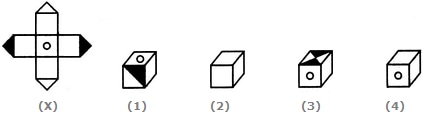
- A.
1
- B.
2
- C.
3
- D.
4
Attempted by 1 students.
Show answer & explanation
Correct answer: D
Concept: In a 'which cube can be formed from this sheet' question, first read off from the net (X) which two faces are opposite each other and which pattern repeats. A folded cube can only show, at any single corner, faces that genuinely sit adjacent to one another once the sheet is folded - so a candidate cube is wrong the instant it puts a stated opposite pair side by side, displays a face pattern the sheet never contains, or crowds more copies of a repeating pattern at one corner than the sheet allows.
Application: Sheet (X) is a cross of four blank arm-squares (top, bottom, left, right) around a centre square bearing a circle - only five squares, one short of a cube's six faces. Each arm-square also carries a small triangular flap beyond its outer edge (the left and right flaps solid black, the top and bottom flaps blank); folding (X) brings these four flaps together to close up the sixth face, giving it a black-cornered, white-bowtie pattern, and this assembled face lands directly opposite the circle face. Among the four blank arm-squares themselves, top-bottom form one opposite pair and left-right form the other, so no three of them can ever be mutually adjacent. Checking each option against these two facts:
(1) is invalid - one visible face is a single black diagonal triangle; sheet (X) only ever produces blank faces, the circle face, and the black-cornered bowtie face, and none of those is a plain single diagonal triangle.
(2) is invalid - it shows three blank faces meeting at one corner, which sheet (X)'s two opposite blank pairs can never produce.
(3) is invalid - it places the circle face and the bowtie face next to each other at one corner, but folding (X) puts them directly opposite each other, so they can never be adjacent.
(4) satisfies both facts - the circle and bowtie faces never touch, and no three blank faces are forced together.
Cross-check: Re-applying the two rules to figure (4) confirms every visible corner is consistent with how sheet (X) folds, and no other option clears both checks - so (4) is the cube formed from (X).