Choose the box that is similar to the box formed by folding the given sheet of…
2024
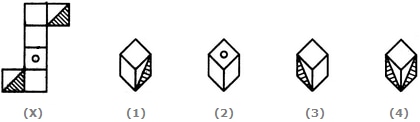
Choose the box that is similar to the box formed by folding the given sheet of paper (X).
- A.
1 and 3 only
- B.
1 and 4 only
- C.
2 and 4 only
- D.
3 and 4 only
Attempted by 1 students.
Show answer & explanation
Correct answer: A
CONCEPT: When a flat net is folded into a cube, two faces attached to each other along a shared edge become ADJACENT faces of the cube, never opposite faces. Two golden sub-rules solve cube-net questions without physically folding: (1) In a straight run of four squares (a row or a column), the 1st and 3rd squares always end up opposite each other, and the 2nd and 4th squares always end up opposite each other, because the four squares wrap around into a closed loop of side faces. (2) A flap folded out perpendicular to one end square becomes adjacent to that square; two such perpendicular flaps coming off different ends of the same run form the third pair of opposite faces. Consequently, any valid 3-face view of a folded cube must show exactly ONE face from each of the three opposite-face pairs -- never two faces from the same pair, since two opposite faces of a cube can never be seen together in a single view.
APPLICATION: Label the four squares running down the column of sheet (X), top to bottom, as A (blank), B (blank), C (the circle face) and D (blank); the flap attached to A is one half-shaded face and the flap attached to D is the other half-shaded face.
By the column rule, the 1st and 3rd squares of the run are opposite, so A is opposite C.
By the same rule, the 2nd and 4th squares of the run are opposite, so B is opposite D.
The two half-shaded flaps come off opposite ends of the same column, so they form the third pair: the two half-shaded faces are opposite each other.
The three opposite pairs are therefore {A, C}, {B, D}, and {the two half-shaded faces}.
Cube (1): top blank, one side shaded, one side blank -- exactly one face from each pair. Valid.
Cube (2): top shows the circle face (C), but both visible side faces are blank -- this forces the two visible sides to be B and D together, yet B and D are themselves an opposite pair and can never both be visible at once. Invalid.
Cube (3): top blank, one side shaded, one side blank -- again exactly one face from each pair. Valid.
Cube (4): both visible side faces are half-shaded -- the two half-shaded faces (an opposite pair) are shown together, which is impossible. Invalid.
CROSS-CHECK: Every valid folding must use exactly three faces, one per opposite pair. Cubes (1) and (3) are the only two candidates that do -- they differ only in which of the two remaining blank faces and which of the two half-shaded faces they show, consistent with two genuinely different valid orientations of the same net. Cubes (2) and (4) each place a same-pair face twice, so neither can be formed from sheet (X).
Hence only the boxes in figures (1) and (3) can be formed by folding sheet (X).