Choose a box that is similar to the box formed from the given sheet of paper…
2025
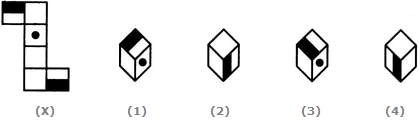
Choose a box that is similar to the box formed from the given sheet of paper (X).
- A.
1 and 2 only
- B.
2 and 3 only
- C.
2 and 4 only
- D.
1, 2, 3 and 4
Attempted by 1 students.
Show answer & explanation
Correct answer: D
Concept: When a flat sheet folds into a cube, two squares belonging to an unbroken run of four connected squares are opposite each other if they are two steps apart in that run; and when the two remaining squares of the net are attached as single side-flaps to the two free ends of that run (on the corresponding side, before folding), folding leaves them as the only two faces still unused, so they end up opposite each other too. A pictorial (isometric) view of a cube always shows exactly three faces meeting at one corner — one face from each of the cube's three opposite pairs — so a genuine opposite pair is never shown together, and a pair is also never left out entirely.
Application: Mapping the six squares of sheet (X) onto the cube:
In sheet (X), four squares — a plain square, the dot square, and two more plain squares — are connected edge-to-edge in an unbroken vertical run. A fifth square (half-shaded) is attached as a side flap to the free edge of the first square of that run, and a sixth square (also half-shaded) is attached as a side flap to the free edge of the last square of that run.
Folding the unbroken run of four closes it into a loop around the cube, so squares that are two steps apart inside that loop land opposite each other: the first plain square of the run is opposite its third square, and the dot square is opposite the fourth (last) square of the run.
The two half-shaded squares are each attached only at the two free ends of that same run, on the corresponding side before folding, so once the run is folded they occupy the only two faces left over on the cube — and since a cube has just three pairs of opposite faces, those two leftover faces must be opposite each other.
This fixes three opposite-face pairs for the cube formed from sheet (X), summarised below.
Opposite pair | Face 1 | Face 2 |
|---|---|---|
Pair 1 | Half-shaded face | Half-shaded face |
Pair 2 | Dot face | A blank face |
Pair 3 | Blank face | Blank face |
Cross-check: Because an isometric view always shows exactly one face from each opposite pair, a genuine contradiction with sheet (X) would show either both half-shaded faces together or neither of them — never exactly one. Checking figures (1), (2), (3) and (4) one by one, each shows exactly one half-shaded face (paired with the dot or a plain face on the other two visible facets), never zero and never two — so none of them contradicts the pairing derived from sheet (X).
Result: Since all four candidate cubes are consistent with the opposite-face pairs fixed by sheet (X), every one of figures (1), (2), (3) and (4) can indeed be formed by folding it — so the correct choice lists all four figures.