Choose the box that is similar to the box formed from the given sheet of paper…
2023
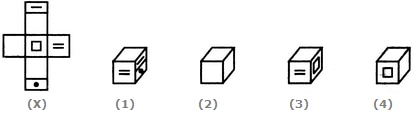
Choose the box that is similar to the box formed from the given sheet of paper ( X).
- A.
1 only
- B.
1 and 3 only
- C.
1, 3 and 4 only
- D.
1, 2, 3 and 4
Attempted by 1 students.
Show answer & explanation
Correct answer: C
When a flat net folds into a cube, two squares that lie in a straight run of four end up as the 1st-and-3rd and 2nd-and-4th pair of that run, and any two squares attached on opposite sides of the same central square also become opposite faces. Two faces that are opposite in the net can never both appear on one three-face view of the folded box, and a face-symbol cannot appear more times in a single view than it actually appears on the net.
Label the six squares of net (X): the top square T bears '-', the centre square C bears a square symbol, its left neighbour L is blank, its right neighbour R bears '=', the square below C is D (blank), and the bottom-most square below D is B, bearing a dot. T, C, D and B form one straight run of four squares, with L and R attached on either side of C.
Opposite face pair | Symbols on each face |
|---|---|
T and D | '-' is opposite the blank face |
C and B | the square face is opposite the dot face |
L and R | the blank face is opposite the '=' face |
Check figure (1): its three visible faces are blank, '=', and a dot. None of these three is the opposite of another - the blank face here is D, and D is adjacent to both the '=' face and the dot face - so this is a valid box.
Check figure (3): its three visible faces are blank, '=', and a square. Again the blank face is D, which is adjacent to both the '=' face and the square face - a valid box.
Check figure (4): its three visible faces are blank, a square, and blank. The square face is adjacent to both blank faces (L and D), and L is adjacent to D - a valid box.
Check figure (2): its three visible faces are blank, blank, and blank - three different faces, all blank. The net has only two blank faces in total (L and D), so no single box view can ever show three distinct blank faces. Figure (2) cannot be formed.
An independent check confirms this without even using the opposite-face pairs: net (X) carries exactly two blank squares, so at most two of the three faces visible on any folded box can be blank. Figure (2) alone shows three blank faces, which is impossible on its own - no adjacency argument is even needed to rule it out.
So the boxes that can be formed from sheet (X) are figures (1), (3) and (4) only; figure (2) cannot be formed.