Choose the box that is similar to the box formed from the given sheet of paper…
2024
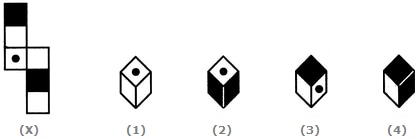
Choose the box that is similar to the box formed from the given sheet of paper (X).
- A.
2 and 3 only
- B.
1, 3 and 4 only
- C.
2 and 4 only
- D.
1 and 4 only
Attempted by 1 students.
Show answer & explanation
Correct answer: B
Concept: In a cube net, when three or more squares form an unbroken straight run (in one row or one column), the two squares separated by exactly one square in that run become OPPOSITE faces once the net is folded into a cube; every other pair of faces in the net ends up ADJACENT. So any 3-face isometric view of the assembled cube must show exactly one face from each of the cube's three opposite-face pairs, never two faces from the same pair.
Application to sheet (X):
Sheet (X) has two straight runs of three squares. The first run gives the pair {one shaded face, the dot face} as opposite (the plain square between them is adjacent to both). The second run gives the pair {a plain face, the second shaded face} as opposite. The two squares left over, both plain, form the third opposite pair.
So the dot face is opposite one shaded face, and can therefore be adjacent to only the OTHER shaded face - it can never be adjacent to both shaded faces at the same time.
Figure (2): its three visible faces show the dot face touching both shaded faces at once. That combination is impossible, since the dot is opposite one of them.
Figures (1), (3) and (4): each shows exactly one face from every opposite pair (dot-or-shade from the first pair, plain-or-shade from the second pair, plain from the third pair), with no pair repeated - every visible trio is consistent with sheet (X), and each is reachable by an actual sequence of folds/rotations of the sheet, with no mirroring needed.
Cross-check: using the opposite-pair rule alone (no need to physically re-fold), a valid cube can never show two faces that are opposite each other in a single 3-face view, and it can never show the dot beside both shaded faces at once, since one shaded face is fixed as the dot's opposite. Figure (2) fails this test; figures (1), (3) and (4) all pass it.
Result: cubes (1), (3) and (4) can be formed from sheet (X); only cube (2) cannot.