Four different positions of the same dice are shown below in figures (i),…
2024
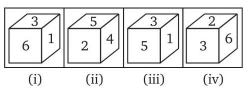
Four different positions of the same dice are shown below in figures (i), (ii), (iii) and (iv). Study the figures and select the number that lies on the face opposite to the face showing the number 3.
- A.
4
- B.
3
- C.
6
- D.
5
Attempted by 4 students.
Show answer & explanation
Correct answer: A
CONCEPT: When several positions (views) of the same dice/cube are shown, two faces that appear together in one view are ADJACENT (neighbouring) faces, never opposite faces. A cube has 6 faces: any one face has 4 adjacent faces and exactly 1 opposite face. So, if a target face is confirmed adjacent to 4 of the other 5 numbers across the given views, the single remaining number must be the one opposite it.
APPLICATION: Take the face showing 3 as the target.
In figure (i), 3 is shown together with 6 and 1, so 3 is adjacent to 6 and 1.
In figure (iii), 3 is shown together with 5 and 1, so 3 is adjacent to 5 and 1 as well.
In figure (iv), 3 is shown together with 2 and 6, so 3 is adjacent to 2 and 6 too.
Pooling all three figures, 3 is confirmed adjacent to 1, 2, 5 and 6 — four different numbers. Since a face has only 4 adjacent faces and a standard dice carries the numbers 1 to 6, the one number never shown together with 3 in any figure is 4. That remaining number must occupy the single face opposite to 3.
CROSS-CHECK: Adding the target face, its 4 adjacent faces, and its 1 opposite face should account for all 6 faces of the dice: 3 (target) + {1, 2, 5, 6} (adjacent) + 4 (opposite) = 6 distinct faces, and indeed no figure ever shows 3 and 4 together — consistent with 4 being opposite to 3.