In a certain code, the word STOP is written as 5827, similarly, the word DROP…
2024
In a certain code, the word STOP is written as 5827, similarly, the word DROP is written as 2968, and the word TED is written as 546. What will be the code for PORT?
- A.
8295
- B.
8265
- C.
8945
- D.
None of these
Attempted by 2 students.
Show answer & explanation
Correct answer: A
Concept
In a set-based number-coding puzzle, a code word's digits form an unordered set that corresponds to the unordered set of its letters — the position of a digit inside the code need not mirror the position of the matching letter inside the word. When two code words share a letter, that letter's digit must lie in the intersection of the two words' digit-sets. Chaining these intersections across every pair of words that share a letter pins down individual letter-to-digit values one at a time.
Application
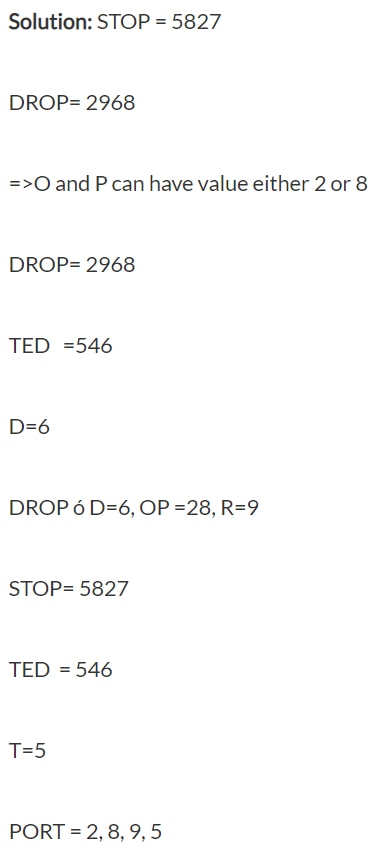
STOP → digit set {5, 8, 2, 7}; DROP → digit set {2, 9, 6, 8}. The letters common to STOP and DROP are O and P, so {O, P} = STOP ∩ DROP = {2, 8}.
STOP → {5, 8, 2, 7}; TED → {5, 4, 6}. The only letter common to STOP and TED is T, so T = STOP ∩ TED = {5}, giving T = 5.
DROP → {2, 9, 6, 8}; TED → {5, 4, 6}. The only letter common to DROP and TED is D, so D = DROP ∩ TED = {6}, giving D = 6.
DROP's full digit set is {2, 9, 6, 8}. Removing the digits already assigned — {O, P} = {2, 8} and D = 6 — leaves R = 9.
TED's full digit set is {5, 4, 6}. Removing T = 5 and D = 6 leaves E = 4, confirming every TED digit is accounted for.
PORT is built from the letters P, O, R, T, so its digit set is {2, 8} ∪ {9} ∪ {5} = {2, 5, 8, 9}.
Cross-check
Compare {2, 5, 8, 9} against the digit sets of the four options: 8295 → {2, 5, 8, 9} (exact match); 8265 → {2, 5, 6, 8} (carries a stray 6); 8945 → {4, 5, 8, 9} (carries a stray 4). Only one option is built from exactly the required four digits, which settles the code even though the internal split between O and P is not independently pinned down by the given words.
So the code for PORT is 8295.