In some alien language: Rosy is dancing is written as "wot cio dim" Rosy keeps…
2023
In some alien language:
Rosy is dancing is written as "wot cio dim"
Rosy keeps singing is written as "yhu ki dim"
Singing is hobby is written as "cio lifg yhu"
Then which word means hobby?
Answer: B. lifg — Concept: In a sentence-coding puzzle, each code word stands for exactly one English word within that coded sentence. When two sentences share an English word,…
- A.
wot
- B.
lifg
- C.
cio
- D.
dim
Attempted by 14 students.
Show answer & explanation
Correct answer: B
Concept: In a sentence-coding puzzle, each code word stands for exactly one English word within that coded sentence. When two sentences share an English word, the code word that is common to both coded versions must represent that shared word. Once every already-identified word-code pair is removed from a sentence, the single word and single code word left over must match each other.
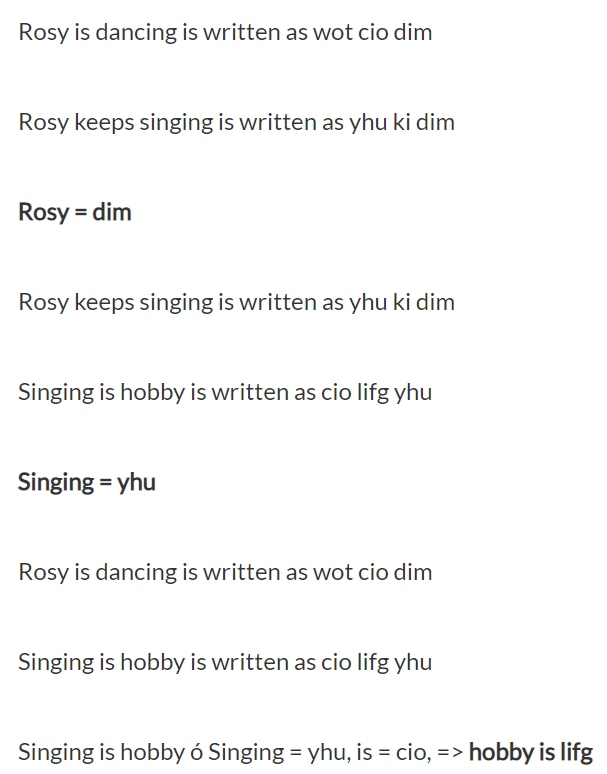
Compare "Rosy is dancing" (wot cio dim) with "Rosy keeps singing" (yhu ki dim): the only word common to both English sentences is Rosy, and the only code common to both coded sentences is dim. So Rosy = dim.
Compare "Rosy keeps singing" (yhu ki dim) with "Singing is hobby" (cio lifg yhu): the common English word is singing, and the common code is yhu. So singing = yhu.
Compare "Rosy is dancing" (wot cio dim) with "Singing is hobby" (cio lifg yhu): the common English word is is, and the common code is cio. So is = cio.
In the third sentence, cio lifg yhu stands for singing, is, hobby. Since cio = is and yhu = singing are already fixed, the one code left, lifg, must stand for the one word left, hobby.
Cross-check: apply Rosy = dim and is = cio back to the first sentence -- the remaining code wot must then stand for the remaining word dancing, which is consistent (dancing appears only in that sentence). Apply Rosy = dim and singing = yhu to the second sentence -- the remaining code ki then stands for keeps, again with no contradiction. Every code word resolves to exactly one word with no clash across all three sentences.
Result: hobby = lifg.