M is the son-in-law of N and the brother-in-law of O, who is the brother of P.…
2025
M is the son-in-law of N and the brother-in-law of O, who is the brother of P. How is O related to N?
- A.
Daughter
- B.
None of these
- C.
Aunt
- D.
Sister
Attempted by 2 students.
Show answer & explanation
Correct answer: B
In blood-relation puzzles, translate each family term into a parent-child or spouse link on a family tree, and let gender-specific words (son, daughter, brother, sister) fix the sex of an otherwise unlabeled person. English 'brother-in-law' can, in the abstract, mean either a spouse's brother or a sibling's husband -- so this class of chained blood-relation question (a person's son-in-law who is also brother-in-law of someone tied to a third named person) is solved, by the standard convention for this puzzle template, by building the ONE family tree in which every named clue connects consistently -- which is exactly what the question's own official worked solution (the family tree shown below) confirms.
M is the son-in-law of N, so M's wife is a daughter of N -- her exact identity is fixed by the next clues, not by this one alone.
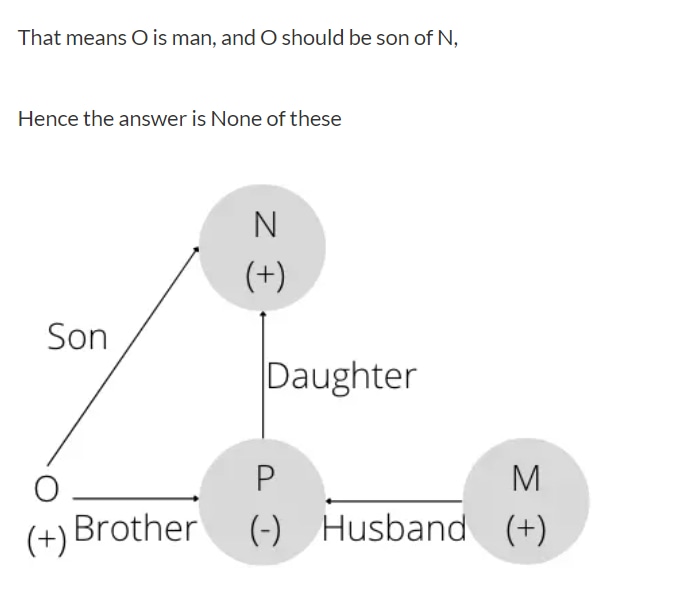
O is the brother of P, and M is also the brother-in-law of O. By the standard convention for this puzzle template -- confirmed here by the accompanying official family-tree solution -- the two clues connect through the same person: M's wife is P. That makes O 'the brother of M's wife', i.e. M's brother-in-law, exactly matching the given clue.
With M's wife confirmed as P, and P confirmed as N's daughter (from step 1), O -- P's brother -- is also a child of N.
The word 'brother' fixes O's sex as male, so O is specifically N's son, not merely a generic child.
Every clue checks out on this tree, exactly as the official worked solution shows: M is P's husband, so M is N's son-in-law; O is P's brother and hence M's wife's brother, so M is O's brother-in-law; and O is N's son.
O is N's son. 'Son' is not among the listed relations (daughter, aunt, sister), so the relation between O and N is not covered by any of the given options -- the correct choice is 'None of these'.