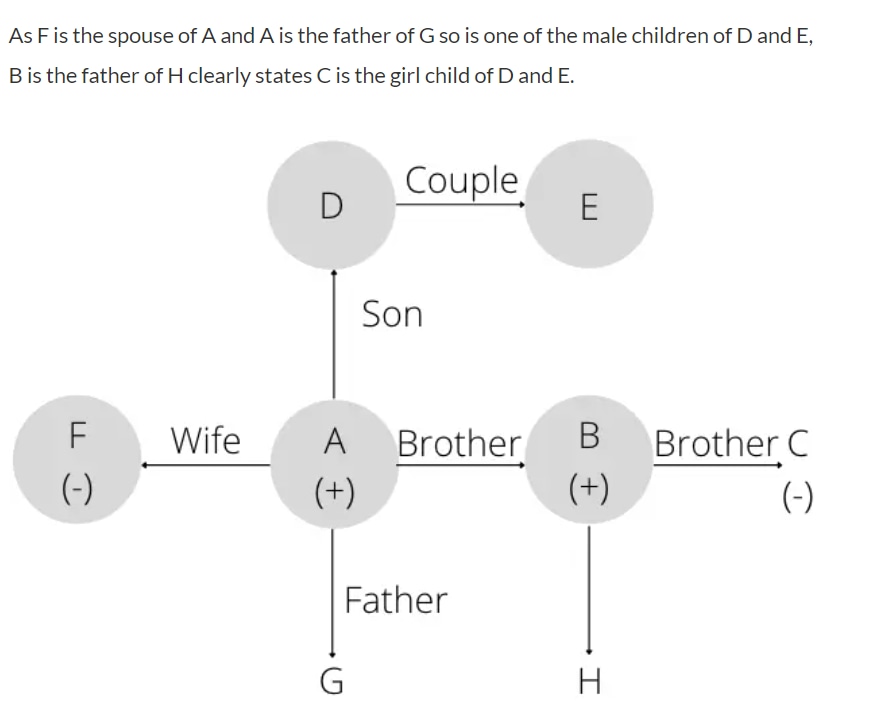
D and E have three children, A, B, and C. F is the spouse of A. G is the…
2023
D and E have three children, A, B, and C. F is the spouse of A. G is the granddaughter of D, whose father is A. B is the father of H. Who is the female child of D and E?
- A.
A
- B.
C
- C.
B
- D.
D
Attempted by 3 students.
Show answer & explanation
Correct answer: B
Concept: In a blood-relation puzzle, a person's gender is fixed only by an explicit role word attached to them by a clue -- father/mother, son/daughter, brother/sister, husband/wife. A bare letter carries no gender on its own. The question itself asserts that a female child of D and E exists among A, B, and C (that is why it asks "who is the female child"); so once every child but one is proven male by such a role word, the remaining, never-proven-male child must be that asserted female child.
D and E have exactly three children: A, B, and C.
"G is the granddaughter of D, whose father is A" names A as G's father -- the role word "father" fixes A as male.
"B is the father of H" names B as H's father -- the role word "father" fixes B as male.
A and B, the only other two of D and E's three children, are both fixed as male by these explicit role words.
The question's own wording ("who is the female child of D and E") asserts that one of D and E's three children IS female -- it would not ask to identify one otherwise. A and B are both proven male by the explicit clues above, so neither of them can be that asserted female child. C is the only one of the three left unproven, so C must be the female child the question is asking about.
Cross-check: F being described only as A's "spouse" (a gender-neutral term) rather than A's husband/wife adds no gender information either way, so it does not disturb this deduction -- the family-tree diagram given with the question independently labels A as a son and C as the girl child of D and E, matching this derivation.
Result: C is the female child of D and E.