D, the son-in-law of B is the brother-in-law of A who is the brother of C. How…
2023
D, the son-in-law of B is the brother-in-law of A who is the brother of C. How is A related to B?
- A.
Brother
- B.
Son
- C.
Father
- D.
Data inadequate
Attempted by 2 students.
Show answer & explanation
Correct answer: B
Concept: Family-relation puzzles are solved by turning every stated relation into a precise, gender-marked family link, then merging the links that share a common person into one family tree. A "son-in-law" link fixes a marriage into the senior party's own children; a "brother-in-law" link fixes either a tie to a spouse's sibling or to a sibling's spouse; a "brother" link fixes a shared parent with a known gender. The asked-for relation is read off once every clue attaches to the same shared person. A well-posed puzzle is built so that exactly one such attachment uses every given clue, which is what fixes the shared identity.
Applying it here:
D is the son-in-law of B, so D is male and married to one of B's daughters -- call her D's wife.
D is also the brother-in-law of A. Since D's wife is a daughter of B, this brother-in-law tie holds when A shares a sibling bond with D's wife, i.e. D's wife is also a sibling of A.
A is the brother of C. Since a well-posed puzzle uses every given clue, this sibling bond is matched to the one found in the previous step -- identifying D's wife as C herself, the only assignment that ties all three statements into a single consistent family tree. C is both B's daughter and A's sibling.
Since C is B's daughter and A is C's sibling, A is also a child of B. The clue calls A a "brother," so A is male -- making A the son of B.
Cross-check: Re-reading the original statements against this family tree confirms every clue holds at once: D married to B's daughter C makes D the son-in-law of B; A being C's sibling makes D the brother-in-law of A; and A being male keeps "brother of C" consistent. No other pairing of the in-law clues ties A back to B at all, so the relation comes out uniquely fixed rather than left undetermined.
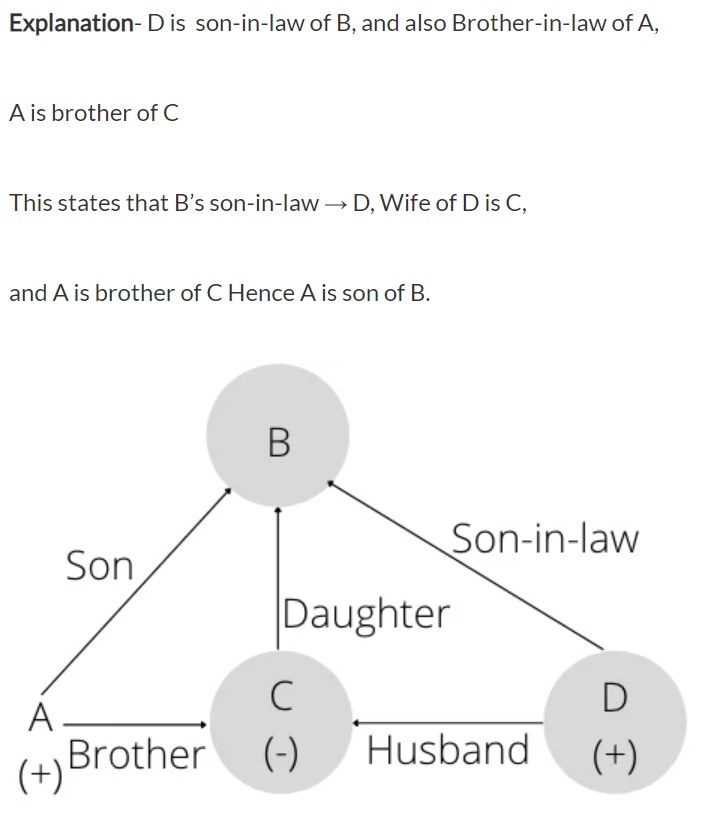
Answer: A is the son of B.