What is the minimum number of straight lines that is needed to construct the…
2024
What is the minimum number of straight lines that is needed to construct the figure?

Answer: B. 13 — Concept: In a composite figure, count DISTINCT straight lines, not drawn segments. Two segments that lie in the same direction and meet at a shared vertex are…
- A.
11
- B.
13
- C.
15
- D.
21
Attempted by 17 students.
Show answer & explanation
Correct answer: B
Concept: In a composite figure, count DISTINCT straight lines, not drawn segments. Two segments that lie in the same direction and meet at a shared vertex are really one continuous straight line (for example, a square's diagonal can run straight on into the side of an adjoining triangle). So group every stroke by direction — horizontal, vertical, each slanting direction — and count once per distinct line.
The figure may be labelled as shown.
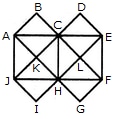
Applying this to the figure:
Horizontal lines: A-C-E (the top row of the two squares) and J-H-F (the bottom row) — 2 lines.
Vertical lines: A-J, C-H and E-F — 3 lines.
Slanting lines: in each square, one diagonal runs straight on into the side of the triangle capping the OPPOSITE square, so the diagonal and that triangle side are a single continuous line — this gives four such long lines. The remaining side of each of the four triangles does not continue into anything else, giving four standalone lines. Total slanting lines = 4 + 4 = 8.
Total straight lines needed = 2 (horizontal) + 3 (vertical) + 8 (slanting) = 13.
Cross-check: counted segment by segment (without merging), the two squares contribute 4 diagonal segments and the four triangles contribute 8 side segments — 12 slanting segments in all. Since 4 of those diagonal segments are collinear continuations of 4 triangle-side segments, they collapse into 8 distinct slanting lines, not 12. Adding the 2 horizontal + 3 vertical boundary lines confirms 5 + 8 = 13 straight lines overall.
So the minimum number of straight lines needed to construct the figure is 13.