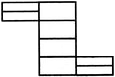
Count the number of rectangles in the given figure.
2023
Count the number of rectangles in the given figure.
- A.
8
- B.
17
- C.
18
- D.
20
Attempted by 3 students.
Show answer & explanation
Correct answer: C
Concept: In a rectangle-counting figure, every valid rectangle must be bounded on all four sides by lines that are actually drawn. Such a rectangle is formed either by one of the smallest bounded cells on its own, or by merging two or more of these cells that lie in a straight line end-to-end, with a fully drawn common edge between every consecutive pair.
Application: The figure has 8 smallest bounded cells: the two half-height cells of the upper-left step (call them T1 above T2), the four equal cells stacked in the middle column (M1 at the top down to M4 at the bottom), and the two half-height cells of the lower-right step (B1 above B2).
Single-cell rectangles (8): T1, T2, M1, M2, M3, M4, B1, B2 - each smallest bounded cell counted on its own.
Two-cell rectangles (5): T1+T2 (the full upper-left step); M1+M2; M2+M3; M3+M4 (three consecutive pairs down the column); B1+B2 (the full lower-right step).
Three-cell rectangles (4): T1+T2+M1 (the upper step merged with the column's first cell); M1+M2+M3; M2+M3+M4 (two consecutive triples down the column); M4+B1+B2 (the column's last cell merged with the lower step).
Four-cell rectangle (1): M1+M2+M3+M4 (the entire middle column, corner to corner).
Adding these: 8 + 5 + 4 + 1 = 18.
Cross-check: Assign vertical boundary lines at x = 0, 1, 2, 3 (x = 0 runs only alongside the upper step; x = 3 runs only alongside the lower step) and the corresponding horizontal boundary lines. A rectangle exists only where both chosen vertical lines and both chosen horizontal lines are fully drawn across the required span. Tallying every valid combination independently across each pair of vertical lines gives 3 + 1 + 0 + 10 + 1 + 3 = 18 - confirming the same total by an independent method.