1296CF : 36F :: 2401DI : ?
2025
1296CF : 36F :: 2401DI : ?
Answer: B. 49G — Concept: In this number-letter analogy, each term pairs a number with letters that encode the digits of that number's square root: take the square root of N,…
- A.
49F
- B.
49G
- C.
36G
- D.
25F
Attempted by 6 students.
Show answer & explanation
Correct answer: B
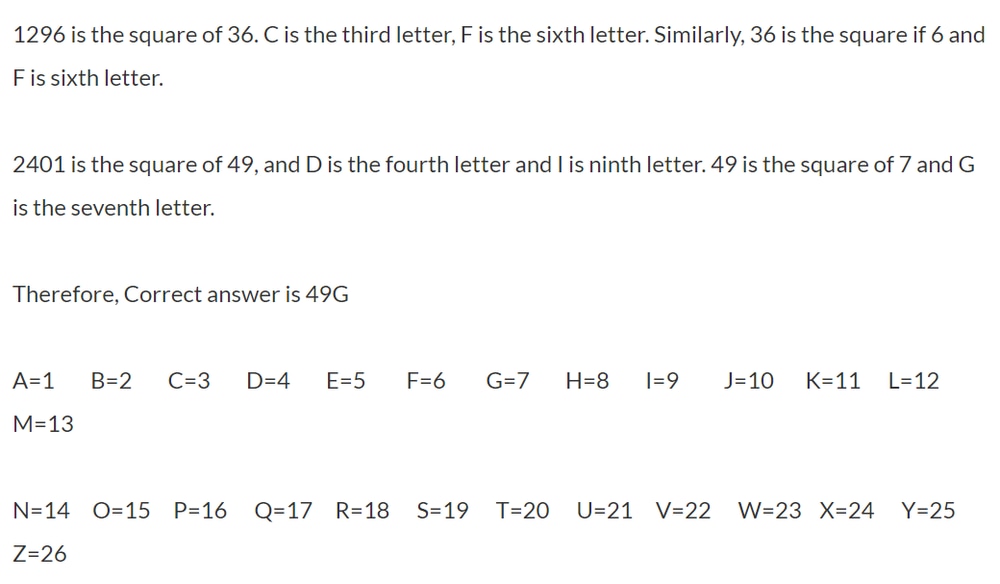
Concept: In this number-letter analogy, each term pairs a number with letters that encode the digits of that number's square root: take the square root of N, then convert every digit of that square root into the letter sitting at that position in the alphabet (A=1, B=2, C=3 ... F=6, G=7 ... I=9).
Application:
Test the rule on the given pair 1296CF : 36F -- the square root of 1296 is 36; the digits 3 and 6 of 36 map to the 3rd and 6th letters, C and F, exactly the letters attached to 1296 (giving 1296CF).
The right-hand term 36F applies the same rule one level down: the square root of 36 is 6; the single digit 6 maps to the 6th letter, F -- matching the F attached to 36.
Apply the identical rule to the second pair's left term: the square root of 2401 is 49; the digits 4 and 9 of 49 map to the 4th and 9th letters, D and I -- matching 2401DI exactly and confirming the rule holds for this pair too.
Now derive the missing right-hand term: the square root of 49 is 7; the single digit 7 maps to the 7th letter, G.
So the completed term is 49G.
Cross-check: The chain 1296 -> 36 -> 6 (giving letters C, F, then F) and the chain 2401 -> 49 -> 7 (giving letters D, I, then the missing letter) are structurally identical at every step -- the same two-stage square-root reduction, the same alphabet-position encoding -- so 49G is the only term consistent with both derivations.
Hence, 2401DI : 49G completes the analogy.