0.2500, 0.1111, 0.0625, 0.0400, 0.0278, ?
2023
0.2500, 0.1111, 0.0625, 0.0400, 0.0278, ?
- A.
0.0204
- B.
0.0256
- C.
0.0219
- D.
0.0196
Attempted by 1 students.
Show answer & explanation
Correct answer: A
Many number-series questions define each term as a function of its position rather than by a fixed additive or multiplicative step. Here every term equals the reciprocal of a perfect square, 1/n2, for consecutive integers n — recognising this closed form lets the sequence be extended to any position directly, without building a difference table.
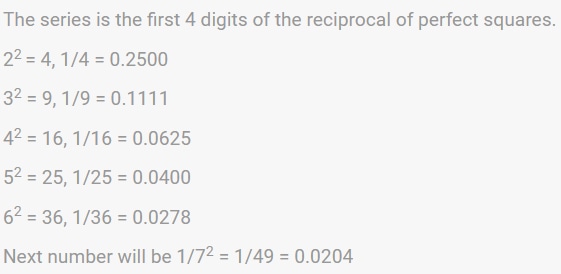
Write every given decimal as an approximate reciprocal of a whole number: 0.2500 = 1/4 (exact), 0.1111 ≈ 1/9 (since 1/9 = 0.1111…, rounded to four decimal places), 0.0625 = 1/16 (exact), 0.0400 = 1/25 (exact), and 0.0278 ≈ 1/36 (since 1/36 = 0.02777…, rounded to four decimal places).
The denominators 4, 9, 16, 25, 36 are 22, 32, 42, 52, 62 — squares of consecutive integers starting from 2.
The integer sequence 2, 3, 4, 5, 6 continues to 7, so the next denominator is 72 = 49.
Compute the next term as 1/49 = 0.020408…, which rounds to 0.0204 at the same four-decimal precision used throughout the sequence.
Taking the reciprocal of 0.0204 gives 1 ÷ 0.0204 ≈ 49.02 — extremely close to the perfect square 49 (= 72), with only the small gap expected from rounding the term itself to four decimal places, exactly like every earlier term in the sequence. Checking the other options the same way, their reciprocals (≈39.06, ≈45.66, ≈51.02) sit nowhere near a perfect square, so none of them can continue this sequence as closely.
So the missing term is 0.0204.