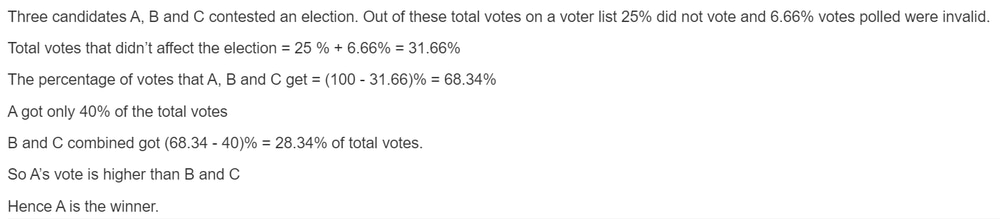
Three candidates A, B and C contested an election. Out of these total votes on…
2023
Three candidates A, B and C contested an election. Out of these total votes on a voter list 25% did not vote and 6.66% votes polled were invalid. C got 2450 valid votes, which were 40% more than that of B. If A got only 40% of the total votes, then who is the winner?
- A.
B
- B.
A
- C.
C
- D.
Can't be determined
Attempted by 7 students.
Show answer & explanation
Correct answer: B
In election-percentage problems, first convert every given percentage to the SAME base (the total voter list), work out the valid votes as a percentage of that base, and then either compare candidates' percentage shares directly, or -- when a candidate's exact vote count is also given -- solve for the actual total voter-list size and cross-check every figure against it.
Let the total number of voters on the list = V (100%).
25% of V did not vote, so votes actually polled = 75% of V.
6.66% of the votes polled (not of the whole list) were invalid; treating this 6.66% as the exam's standard shorthand for the recurring fraction 6⅔% = 20/3% (an interpretation the clean whole-number results below will confirm), invalid votes = (20/3)% of 75% of V = exactly 5% of V.
So valid votes = votes polled - invalid votes = 75% - 5% = 70% of V.
A received 40% of the total number of voters on the voter list -- the same base V already used for the 25% who did not vote -- i.e. A's votes = 40% of V.
So B and C together = valid votes - A's votes = 70% - 40% = 30% of V.
C got 2450 valid votes, which were 40% more than B's, so B = 2450 / 1.4 = 1750 votes; hence B + C = 1750 + 2450 = 4200 votes.
Since B + C = 4200 votes equals 30% of V, the total voter list V = 4200 / 0.30 = 14,000.
So A's votes = 40% of 14,000 = 5,600.
Cross-check: total valid votes should be 70% of 14,000 = 9,800, and indeed A + B + C = 5,600 + 1,750 + 2,450 = 9,800 -- matches exactly. Also, invalid votes = 5% of 14,000 = 700 and non-voters = 25% of 14,000 = 3,500, so the grand total 5,600 + 1,750 + 2,450 + 700 + 3,500 = 14,000, matching V exactly. Every given percentage and count is consistent with this single value of V, confirming the working. (Even under the alternative reading that A's 40% refers to votes actually polled rather than the full voter list, A's tally would work out to 3,150 -- still ahead of both B (1,750) and C (2,450) individually -- so the winner is unaffected by this ambiguity.)
A (5,600 votes) is ahead of both B (1,750) and C (2,450) individually -- in fact ahead of B and C's combined total (4,200) as well. So A is the winner.