A and B enter into a partnership and invest Rs. 16,000 and Rs. 15,000…
2025
A and B enter into a partnership and invest Rs. 16,000 and Rs. 15,000 respectively. After 9 months, C also joins the business with a capital of Rs. 20,000. The share of C in a profit of Rs. 36,540 after two years is:
Answer: C. Rs 10,500 — Concept: When partners invest different amounts for different time periods, the profit is divided in the ratio of each partner's (capital invested) x (time…
- A.
Rs 12,600
- B.
Rs 13,400
- C.
Rs 10,500
- D.
Rs 14,400
Attempted by 1 students.
Show answer & explanation
Correct answer: C
Concept: When partners invest different amounts for different time periods, the profit is divided in the ratio of each partner's (capital invested) x (time period invested), not simply in the ratio of capitals. This capital-time (capital-months) product captures both how much money was put in and for how long, and is the basis for splitting any partnership profit when investments start or end at different times.
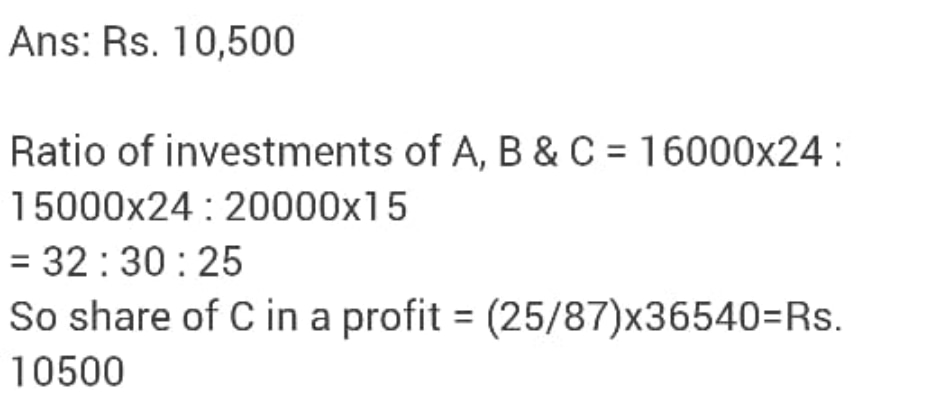
A invests Rs. 16,000 as a founding partner, so A's money works for the full two-year period, i.e. 24 months.
B invests Rs. 15,000, also as a founding partner, so B's money is also invested for the full 24 months.
C joins only after 9 months, contributing Rs. 20,000. Since the total period under consideration is 24 months, C's capital works for only 24 - 9 = 15 months.
Find each partner's capital-time product: A = 16,000 x 24 = 3,84,000; B = 15,000 x 24 = 3,60,000; C = 20,000 x 15 = 3,00,000.
Divide all three products by their common factor 12,000 to get the simplified profit-sharing ratio A : B : C = 32 : 30 : 25.
Add the ratio parts: 32 + 30 + 25 = 87. So the total profit of Rs. 36,540 is divided into 87 equal parts, each worth 36,540 / 87 = Rs. 420.
C's share corresponds to 25 parts, so C receives 25 x 420 = Rs. 10,500.
Cross-check: Using the same per-part value, A's share is 32 x 420 = Rs. 13,440 and B's share is 30 x 420 = Rs. 12,600. Adding all three shares: 13,440 + 12,600 + 10,500 = Rs. 36,540, which matches the total profit exactly, confirming the ratio and the division are consistent.