A and B started a business with Rs. 15,000 and Rs. 12,000 respectively. After…
2024
A and B started a business with Rs. 15,000 and Rs. 12,000 respectively. After 6 months, B puts Rs. 1,000 more into his capital, while after 8 months, A puts Rs. 5,000 more into his capital. If there is a profit of Rs. 35,000 after one year, then what will be B's share?
Answer: A. Rs. 15,000 — Concept: When partners change their invested capital at different points during the year, profit is shared in the ratio of each partner's EQUIVALENT CAPITAL —…
- A.
Rs. 15,000
- B.
Rs. 18,000
- C.
Rs. 16,000
- D.
Rs. 20,000
Attempted by 2 students.
Show answer & explanation
Correct answer: A
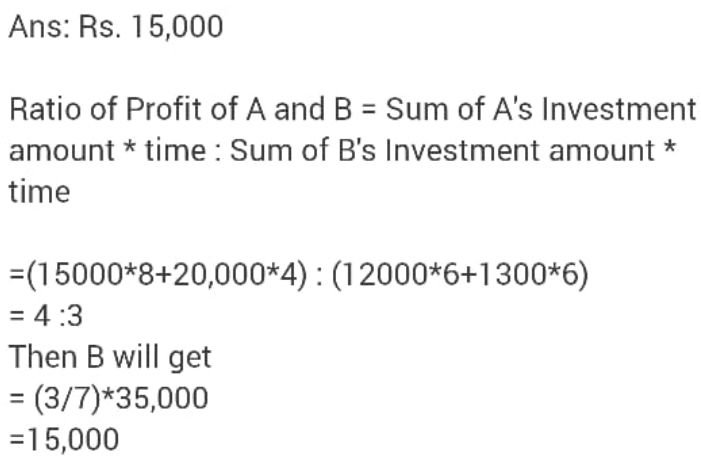
Concept: When partners change their invested capital at different points during the year, profit is shared in the ratio of each partner's EQUIVALENT CAPITAL — the capital amount multiplied by the number of months it was actually invested, summed over every period — not in the ratio of the raw initial investments.
A invested Rs. 15,000 for the first 8 months, then Rs. 20,000 (after adding Rs. 5,000) for the remaining 4 months. A's equivalent capital = (15,000 × 8) + (20,000 × 4) = 1,20,000 + 80,000 = 2,00,000.
B invested Rs. 12,000 for the first 6 months, then Rs. 13,000 (after adding Rs. 1,000) for the remaining 6 months. B's equivalent capital = (12,000 × 6) + (13,000 × 6) = 72,000 + 78,000 = 1,50,000.
The profit-sharing ratio of A to B is therefore 2,00,000 : 1,50,000 = 4 : 3.
Total parts = 4 + 3 = 7, so B's share of the Rs. 35,000 profit = (3/7) × 35,000 = Rs. 15,000.
Cross-check: A's share = (4/7) × 35,000 = Rs. 20,000, and Rs. 20,000 + Rs. 15,000 = Rs. 35,000, which matches the total profit, confirming the split is correct.
Hence, B's share of the profit is Rs. 15,000.