Which of the following numbers are prime? 1, 6.3, 11, 14, 13, 21, 23, 4/5,…
2024
Which of the following numbers are prime? 1, 6.3, 11, 14, 13, 21, 23, 4/5, 100, 123.
Answer: A. 11, 13, 23 — A prime number is a whole number greater than 1 with exactly two factors: 1 and itself. A composite number has more than two factors. A number that is not a…
- A.
11, 13, 23
- B.
22, 21, 14
- C.
16, 17, 18
- D.
31, 56, 96
Attempted by 95 students.
Show answer & explanation
Correct answer: A
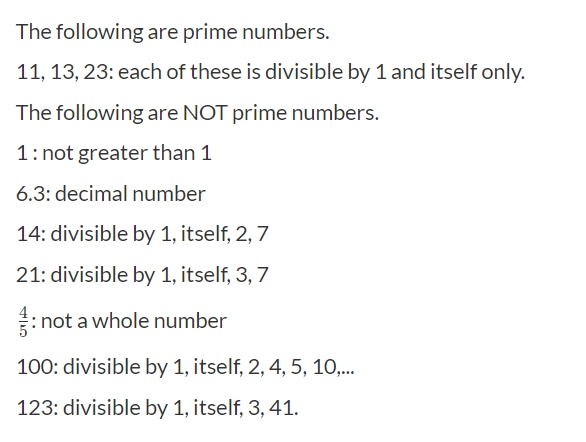
A prime number is a whole number greater than 1 with exactly two factors: 1 and itself. A composite number has more than two factors. A number that is not a whole number — a decimal or a fraction — cannot be prime or composite at all.
Number | Classification | Reason |
|---|---|---|
1 | Not prime | Not greater than 1 |
6.3 | Not prime | Decimal — not a whole number |
11 | Prime | Divisible only by 1 and itself |
14 | Not prime | 14 = 2 × 7 |
13 | Prime | Divisible only by 1 and itself |
21 | Not prime | 21 = 3 × 7 |
23 | Prime | Divisible only by 1 and itself |
4/5 | Not prime | Fraction — not a whole number |
100 | Not prime | 100 = 2 × 2 × 5 × 5 (many factors) |
123 | Not prime | 123 = 3 × 41 |
Checking each candidate prime by trial division up to its square root confirms this: 11 (√11 ≈ 3.3) is not divisible by 2 or 3; 13 (√13 ≈ 3.6) is not divisible by 2 or 3; 23 (√23 ≈ 4.8) is not divisible by 2 or 3. No smaller divisor exists for any of them, so all three are genuinely prime.
So the primes in the list are exactly 11, 13, and 23 — the only three numbers in the list with exactly two factors.