The following pie-chart shows the percentage distribution of the expenditure…
2025
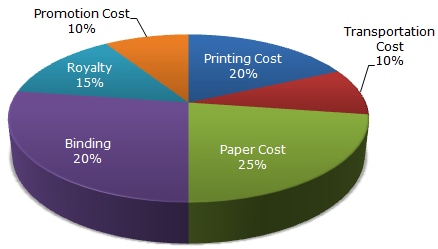
The following pie-chart shows the percentage distribution of the expenditure incurred in publishing a book. Study the pie-chart and answer the questions based on it. Various Expenditures (in percentage) Incurred in Publishing a Book
If 5500 copies are published and the transportation cost on them amounts to Rs. 82,500, then what should be the selling price of the book so that the publisher can earn a profit of 25%?
- A.
Rs. 187.50
- B.
Rs. 191.50
- C.
Rs. 175
- D.
Rs. 180
Attempted by 1 students.
Show answer & explanation
Correct answer: A
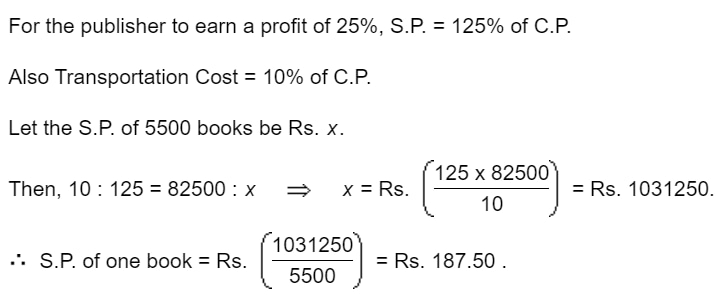
When a percentage pie-chart splits a total cost into parts, each labelled percentage is that part's share of the very same total cost, so any one part's rupee value fixes the whole total through a simple ratio: part % is to part value as 100% is to total value. Separately, to earn a specific profit percentage on the cost price (CP), the required selling price (SP) is found by scaling: SP = CP × (100 + profit%)/100 — the SP is always obtained by scaling the CP by this ratio, never by adding a flat rupee amount to it.
From the chart, Transportation Cost is 10% of the total production cost, and this 10% share equals Rs. 82,500 for all 5,500 copies.
Scale up using the percentage-to-value ratio: 10% corresponds to Rs. 82,500, so 100% (the total cost, i.e., the cost price for all 5,500 copies) = 82,500 × (100/10) = Rs. 8,25,000.
For a 25% profit, SP = CP × 125/100, so the total selling price for all 5,500 copies = 8,25,000 × 125/100 = Rs. 10,31,250.
Selling price per copy = 10,31,250 ÷ 5,500 = Rs. 187.50.
Cross-check with an independent route: the per-copy transportation cost is 82,500 ÷ 5,500 = Rs. 15; since this Rs. 15 is 10% of the per-copy cost price, the per-copy cost price is 15 × 10 = Rs. 150; applying the 125% profit factor gives 150 × 1.25 = Rs. 187.50 — the same result as the aggregate route, confirming the answer.