Fourteen persons are sitting around a circular table facing the centre. What…
2024
Fourteen persons are sitting around a circular table facing the centre. What is the probability that three particular persons sit together?
Answer: D. 1/26 — Concept For n distinct people seated around a circular table, the number of distinct seatings (rotations treated as identical) is (n-1)!. When a specific set…
- A.
2/9
- B.
1/13
- C.
2/13
- D.
1/26
Attempted by 3 students.
Show answer & explanation
Correct answer: D
Concept
For n distinct people seated around a circular table, the number of distinct seatings (rotations treated as identical) is (n-1)!. When a specific set of k people must sit together, treat that block as one unit: it reduces the count to (n-k+1) units arranged in a circle, i.e. (n-k)! ways, and the k people inside the block can be ordered among themselves in k! ways. So P(all k sit together) = [(n-k)! × k!] / (n-1)!.
Application
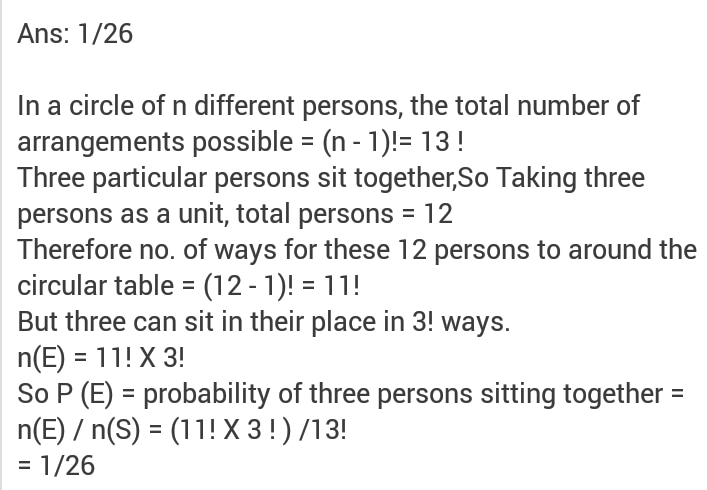
Total circular arrangements of all 14 people: (14 - 1)! = 13!.
Treat the three particular persons as a single block. The block plus the remaining 11 people form 12 units, so the block can be positioned in (12 - 1)! = 11! circular ways.
Within the block, the three persons can be ordered among themselves in 3! = 6 ways.
Favourable arrangements = 11! × 3! = 11! × 6.
Required probability = (11! × 6) / 13! = 6 / (13 × 12) = 6/156 = 1/26.
Cross-check
Fix one of the three particular persons at any seat (valid since only relative positions matter in a circle). The trio of consecutive seats containing this fixed person can be arranged in 3 ways relative to them (as the first, middle, or last seat of the block). The other two particular persons then fill the remaining two seats of that block in 2! ways, and the rest of the 11 people fill the remaining 11 seats in 11! ways. This gives 3 × 2! × 11! favourable orders out of 13! total orders of the other 13 people: (3 × 2 × 11!)/13! = 6/(13×12) = 1/26 — matching the block-method result.