A leather box contains 8 black balls and 6 white balls. Two draws of three…
2025
A leather box contains 8 black balls and 6 white balls. Two draws of three balls each are made, the balls being replaced after the first draw. What is the probability that the balls were black in the first draw and white in the second draw?
Answer: A. 70/8281 — Concept: When a group of items is picked from a fixed pool without looking at order, the probability of getting a specific group equals (ways to pick the…
- A.
70/8281
- B.
140/20449
- C.
25/5445
- D.
35/5448
Attempted by 4 students.
Show answer & explanation
Correct answer: A
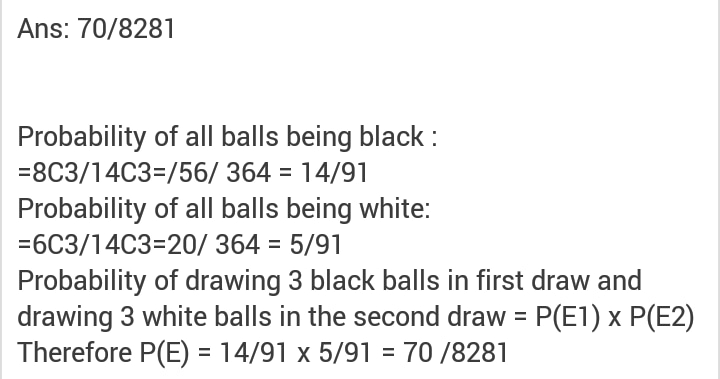
Concept: When a group of items is picked from a fixed pool without looking at order, the probability of getting a specific group equals (ways to pick the favourable group) ÷ (ways to pick any group of that size) — that is, the ratio of combinations nCr. If a second draw happens from the SAME pool AFTER everything drawn the first time is put back ("replaced"), the pool is identical for both draws and the two draws become independent events, so the probability of both happening together is the PRODUCT of their individual probabilities: P(first event) × P(second event).
Application:
Total balls in the box = 8 black + 6 white = 14, and each draw takes out 3 balls, so the total number of equally likely ways for any single draw of 3 balls is C(14,3) = 364.
First draw — all 3 black: the number of favourable ways is C(8,3) = 56, so P(first draw is 3 black) = 56/364 = 14/91.
Because the 3 balls drawn are replaced, the box is back to 8 black + 6 white = 14 balls before the second draw, so the total ways for the second draw is again C(14,3) = 364.
Second draw — all 3 white: the number of favourable ways is C(6,3) = 20, so P(second draw is 3 white) = 20/364 = 5/91.
Since the two draws are independent (replacement restores the pool), multiply the two probabilities: P(black then white) = (14/91) × (5/91) = 70/8281.
Cross-check: Reduce each single-draw probability fully instead of stopping at /4: C(8,3)/C(14,3) = 56/364 = 2/13 and C(6,3)/C(14,3) = 20/364 = 5/91, so the product is (2/13) × (5/91) = 10/1183. Dividing 70/8281 by 7 in both numerator and denominator gives exactly 10/1183 too — the two ways of reducing the fractions agree, confirming the value.
Result: The required probability is 70/8281.