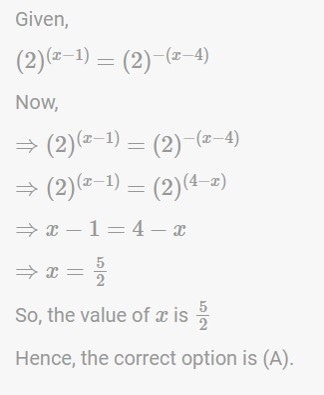
If (2)(x − 1) = (2)−(x − 4), then find the value of x?
2025
If (2)(x − 1) = (2)−(x − 4), then find the value of x?
Answer: A. 5/2 — Concept: For an exponential equation with equal bases, am = an (a > 0, a ≠ 1), the exponential function is strictly one-to-one, so the equation holds only…
- A.
5/2
- B.
3/2
- C.
3/9
- D.
7/8
Attempted by 14 students.
Show answer & explanation
Correct answer: A
Concept: For an exponential equation with equal bases, am = an (a > 0, a ≠ 1), the exponential function is strictly one-to-one, so the equation holds only when the exponents themselves are equal: m = n.
Application: Here both sides have base 2, so equate the exponents (x − 1) and −(x − 4):
Write the exponent equation: x − 1 = −(x − 4).
Expand the right side fully: −(x − 4) = −x + 4, giving x − 1 = −x + 4.
Collect the x-terms on one side and the constants on the other: x + x = 4 + 1, so 2x = 5.
Solve for x: x = 5/2.
Cross-check: Substitute x = 5/2 back into each exponent: LHS exponent = 5/2 − 1 = 3/2; RHS exponent = −(5/2 − 4) = −(−3/2) = 3/2. Both sides give the same exponent, 3/2, so 23/2 = 23/2 holds, confirming the value.