If x, y and z are consecutive negative integers, and if x > y > z, which of…
2025
If x, y and z are consecutive negative integers, and if x > y > z, which of the following must be a positive odd integer ?
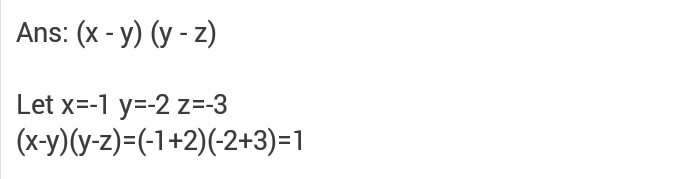
Answer: B. (x - y) (y - z) — Consecutive integers differ from each other by exactly 1. So if x, y and z are consecutive integers with x > y > z, then x - y = 1 and y - z = 1, and this…
- A.
xyz
- B.
(x - y) (y - z)
- C.
x - yz
- D.
x + y + z
Attempted by 2 students.
Show answer & explanation
Correct answer: B
Consecutive integers differ from each other by exactly 1. So if x, y and z are consecutive integers with x > y > z, then x - y = 1 and y - z = 1, and this holds regardless of which specific integers are chosen. Also recall the sign rules: the product of an odd number of negative numbers is negative, the product of two negative numbers is positive, and the sum of negative numbers is always negative.
Since x, y, z are consecutive integers with x > y > z, by definition x - y = 1 and y - z = 1.
Substitute any valid consecutive negative triple to verify, for example x = -1, y = -2, z = -3 (so x > y > z holds).
Compute (x - y)(y - z) = (-1 - (-2)) × (-2 - (-3)) = (1)(1) = 1.
1 is positive and odd, satisfying the requirement -- and this result is invariant for any consecutive triple, since it always reduces to 1 × 1.
Checking the remaining expressions with the same values confirms none of them can be positive:
xyz = (-1)(-2)(-3) = -6, which is negative, so it fails.
x - yz = -1 - (-2)(-3) = -1 - 6 = -7, which is negative, so it fails.
x + y + z = -1 + (-2) + (-3) = -6, which is negative, so it fails.
Hence (x - y)(y - z) is the expression guaranteed to be a positive odd integer.