In each question below, there are two or three statements followed by four…
2024
In each question below, there are two or three statements followed by four conclusions numbered I, II, III and IV. Take the given statements to be true even if they seem to be at variance with commonly known facts and then decide which of the given conclusions logically follow(s) from the given statements.
Statements:
A. Some oranges are apples.
B. All apples are guavas.
C. No guavas are bananas.
Conclusions:
I. Some guavas are oranges.
II. No apples are bananas.
III. Some oranges are bananas.
IV. Some apples are bananas.
Answer: A. Only I and II follow — Concept: A single valid conclusion can be drawn by combining two premises through the term common to both (the middle term). Two standard valid patterns apply…
- A.
Only I and II follow
- B.
Only I and either II or IV follow
- C.
Only I, II and IV follow
- D.
Only III and either II or IV follow
Attempted by 5 students.
Show answer & explanation
Correct answer: A
Concept: A single valid conclusion can be drawn by combining two premises through the term common to both (the middle term). Two standard valid patterns apply here: “Some A are B” + “All B are C” → “Some A are C” (which converts to “Some C are A”); and “All A are B” + “No B are C” → “No A are C”. When two conclusions are exact opposites (one “No X are Y”, the other “Some X are Y”), the either-or rule applies only when NEITHER follows directly from the premises — if one of them already follows by a valid syllogism, that one alone holds and its opposite is automatically false.
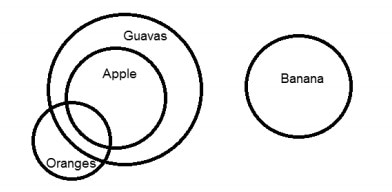
Application to this question:
Combine statement A (“Some oranges are apples”) with statement B (“All apples are guavas”) through the shared term “apples”: the oranges that are apples are also guavas, so “Some oranges are guavas”, which converts to “Some guavas are oranges” — Conclusion I follows.
Combine statement B (“All apples are guavas”) with statement C (“No guavas are bananas”) through the shared term “guavas”: every apple is a guava and no guava is a banana, so no apple can be a banana — Conclusion II follows.
Conclusion III (“Some oranges are bananas”) has no supporting chain: the only established facts link oranges to guavas through the apple overlap, and separately show guavas disjoint from bananas — nothing in the statements says anything about the rest of the orange region, so a positive oranges–bananas relationship can never be validly derived; Conclusion III does not follow (it is unproven, not disproven).
Conclusion IV (“Some apples are bananas”) is the exact opposite of Conclusion II (“No apples are bananas”), which is already proven valid; since II holds, IV cannot also hold.
Cross-check: the accompanying Venn diagram is drawn consistent with this derivation — the apple region entirely inside the guava region, the orange region overlapping only that apple portion, and the banana region separate from guava (and hence from the apple subset) — with no connection drawn between oranges and bananas anywhere, matching the fact that Conclusion III has no basis to be drawn, while Conclusion IV is ruled out directly as the opposite of the proven Conclusion II.
Result: Only conclusions I and II follow.