In each question below, there are two or three statements followed by four…
2024
In each question below, there are two or three statements followed by four conclusions numbered I, II, III and IV. Take the given statements to be true even if they seem to be at variance with commonly known facts, and then decide which of the given conclusions logically follow(s) from the given statements.
Statements:
A. Some streets are roads.
B. Some roads are lanes.
C. Some lanes are highways.
Conclusions:
I. Some roads are not streets.
II. No highways are streets.
III. Some streets are not roads.
IV. Some lanes are not roads.
Answer: D. None of these — Concept: A conclusion is valid only if it follows necessarily from the premises. Two rules apply here — (1) two Particular ('Some...are') premises never yield…
- A.
Only III follows
- B.
Only III and IV follow
- C.
Either I or III follows
- D.
None of these
Attempted by 4 students.
Show answer & explanation
Correct answer: D
Concept: A conclusion is valid only if it follows necessarily from the premises. Two rules apply here — (1) two Particular ('Some...are') premises never yield a valid conclusion linking their non-shared extreme terms; (2) a Particular Affirmative premise only confirms an overlap between two groups, so it can never imply the matching negative statement ('Some...are not') about the same pair, since that would need evidence of exclusion the premise doesn't give.
All three statements — Some streets are roads, Some roads are lanes, Some lanes are highways — are Particular Affirmative (I-type) premises.
Conclusion II links Highways and Streets, the two extreme (non-adjacent) terms of the three-statement chain. By rule (1), two Particular premises chained together never yield a conclusion about their extreme terms, so II does not follow.
Conclusions I and III are the two negative converses of statement A (Some streets are roads). By rule (2), an affirmative 'Some' premise cannot imply either negative claim about the same pair of terms, so neither I nor III follows.
Conclusion IV is the negative converse of statement B (Some roads are lanes). The same rule (2) applies, so IV does not follow either.
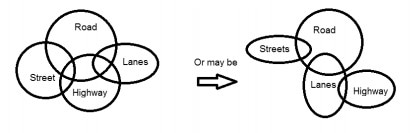
Cross-check: as the diagram shows, more than one arrangement of the four groups is consistent with all three 'Some' statements at once, and no arrangement forces any of I, II, III or IV to hold in every case. None of the four conclusions forms a complementary pair either, so no single one is guaranteed.
Hence, none of the given conclusions logically follow.