Direction: In the question, few statements followed by two conclusions…
2025
Direction: In the question, few statements followed by two conclusions numbered I and II. You have to take the given statements to be true even if they seem to be at variance with commonly known facts. Read all the conclusions and then decide which of the given conclusions logically follows from the given statements, disregarding commonly known facts.
Statements:
All Lassi are Curd.
Some Curd are Pasta.
Only a few Pasta are Pizza.
Conclusions:
I. Some Pizza can never be Lassi.
II. Some Pizza can be Lassi.
Answer: B. If only conclusion II follows — Concept: In syllogism problems that mix a definite premise (All/No) with particular premises (Some), a relationship between two extreme terms is only a…
- A.
If only conclusion I follows
- B.
If only conclusion II follows
- C.
If either conclusion I or II follows
- D.
If neither conclusion I nor II follows
Attempted by 8 students.
Show answer & explanation
Correct answer: B
Concept: In syllogism problems that mix a definite premise (All/No) with particular premises (Some), a relationship between two extreme terms is only a possibility when no premise forces it to be true or false in every valid diagram. A possibility conclusion ("X can be Y") follows whenever at least one Venn diagram consistent with the statements shows the overlap; a "never" conclusion (asserting the overlap is impossible in every diagram) fails as soon as even one valid diagram allows the overlap.
Application:
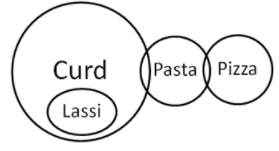
All Lassi are Curd — draw the Lassi circle entirely inside the Curd circle.
Some Curd are Pasta — draw a partial overlap between the Curd and Pasta circles; the Lassi circle may or may not fall inside this overlap since no statement restricts it.
Only a few Pasta are Pizza (some Pasta are Pizza and some Pasta are not Pizza) — draw a partial overlap between the Pasta and Pizza circles.
The Curd-Pasta overlap and the Pasta-Pizza overlap can be positioned so the Pizza circle reaches into the Lassi circle through the shared Curd-Pasta-Pizza region, so at least one valid diagram lets some Pizza fall inside Lassi.
No statement forbids this overlap, so it is a genuine possibility — hence Conclusion II ("Some Pizza can be Lassi") follows.
Conclusion I claims the overlap is impossible in every diagram ("can never be") — but the diagram above is a valid counter-example, so this absolute claim fails.
Reference Venn diagram:
Cross-check: A diagram with the overlap is just as valid as one without it, so the statements do not force the overlap to happen every time, but they also do not forbid it. That is exactly the bar a "can be" possibility conclusion needs to clear.
Result: Conclusion II clears that bar; Conclusion I, which claims the overlap is impossible in every case, does not. Hence, only Conclusion II follows.