Directions: The given question consists of two sets of figures. In the first…
20232025
Directions: The given question consists of two sets of figures. In the first set both the boxes have been related by some analogy. On the same pattern find the answer for the given figure box.
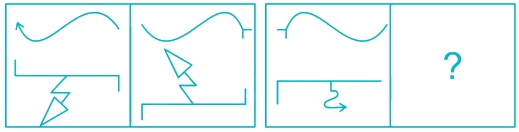
Attempted by 10 students.
Show answer & explanation
Concept
In a figure-analogy (figure-matrix) item, the first pair of boxes always encodes ONE fixed transformation applied to every independent element of the figure. The exact same transformation, applied unchanged to the third figure, must pick out the fourth. Here the figure has two independent parts, so there are two rules to track at once: an end-marker rule on the curved line, and a top-to-bottom "water image" (mirror) reflection on the bracket-and-squiggle group below it.
Application
Track the curved line's end-markers from the first figure to the second: a triangular arrowhead sits at the left end (plain at the right) in the first figure, while in the second figure the left end is plain and a perpendicular tick sits at the right end. So the marker relocates from the left end to the right end, and its shape alternates between an arrowhead and a tick each time it moves.
Track the bracket-and-squiggle group below the curve: in the first figure the short vertical stands above the baseline on the left and dips below it on the right, and the zig-zag hangs below the baseline ending in a downward-pointing arrowhead. In the second figure every one of these is reflected top-to-bottom about the baseline: the vertical now dips below on the left and rises above on the right, and the squiggle sits above the baseline ending in an upward-pointing arrowhead. This confirms a full vertical mirror ("water image") of the whole lower group between the two given figures.
Apply both rules to the third figure. Its curve already carries the tick at the left end (plain at the right), so the marker must relocate to the right end and switch to an arrowhead. Its lower group has the vertical dipping below the baseline on the left with a flat, unmarked right edge, and a squiggle hanging below the baseline that ends in a rightward-pointing arrowhead. Reflecting this group top-to-bottom keeps the right edge flat (it has no vertical component to flip), sends the left vertical up above the baseline, and moves the squiggle above the baseline while its arrowhead keeps pointing in the same horizontal direction, i.e. still to the right.
Cross-check
Only one of the four figures shows both required changes together: the curve plain at the left with an arrowhead at the right, together with the lower group's left vertical rising above the baseline, its right edge staying flat, and its squiggle sitting above the baseline still ending in a rightward arrowhead. Every other figure keeps at least one part unchanged or altered the wrong way — an unmoved or wrongly-typed curve marker, a lower group that is not reflected top-to-bottom, or a squiggle arrow reversed in direction — so it breaks one of the two rules established by the first pair.
The figure satisfying both rules simultaneously is the answer.