Ricky travels 5 km, then takes a right turn and travels 6 km. He then takes a…
2024
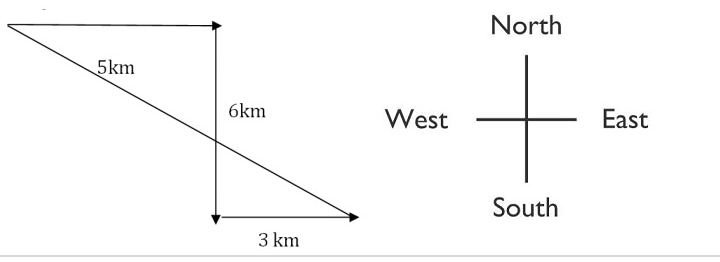
Ricky travels 5 km, then takes a right turn and travels 6 km. He then takes a left turn and travels 3 km. Find his final distance from home.
Answer: A. 10 km — Concept: In a direction-and-distance problem where the path turns only through right angles, resolve every leg of the journey onto two perpendicular axes…
- A.
10 km
- B.
12 km
- C.
13 km
- D.
16 km
Attempted by 1 students.
Show answer & explanation
Correct answer: A
Concept: In a direction-and-distance problem where the path turns only through right angles, resolve every leg of the journey onto two perpendicular axes (say, North–South and East–West). The straight-line distance from the start is then found using the Pythagorean theorem: distance2 = (net displacement along one axis)2 + (net displacement along the other axis)2.
Let Ricky start at home and walk the first 5 km in some direction — call this axis A.
He takes a right turn (a 90° turn onto the perpendicular axis, axis B) and walks 6 km along axis B.
He then takes a left turn — turning 90° back onto axis A — and walks a further 3 km along axis A, in the same direction as his very first leg.
Adding the two legs along axis A: 5 km + 3 km = 8 km net displacement along axis A. Only one leg (6 km) lies along axis B, so the net displacement along axis B is 6 km.
Apply the Pythagorean theorem to the two perpendicular displacements: distance = √(82 + 62) = √(64 + 36) = √100 = 10 km.
Cross-check: 8-6-10 is simply 2× the well-known 3-4-5 right triangle, so the arithmetic checks out without a calculator. Also, since the whole path can be rotated to face any initial direction without changing its shape, the resulting distance is the same no matter which way Ricky originally set off.
Answer: The final distance from home is 10 km.