Choose the box that is similar to the box formed from the given sheet of paper…
2024
Choose the box that is similar to the box formed from the given sheet of paper (X).
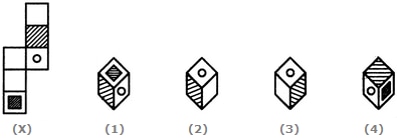
Answer: B. 1, 2 and 4 only — ConceptA cube has six faces, and each face has exactly one face directly opposite it while the remaining four faces are its neighbours. Folding a flat net…
- A.
1 and 2 only
- B.
1, 2 and 4 only
- C.
2 only
- D.
3 and 4 only
Attempted by 5 students.
Show answer & explanation
Correct answer: B
Concept
A cube has six faces, and each face has exactly one face directly opposite it while the remaining four faces are its neighbours. Folding a flat net into a cube fixes two things for good: which faces end up opposite each other, and the one rotational — never mirrored — arrangement in which any three mutually adjacent faces can be seen together at a shared corner. So checking a candidate cube picture means finding the net's opposite pairs first, then confirming the visible faces are never one such pair, and that their left-right arrangement matches a genuine rotation and not its mirror image.
Applying it to sheet (X)
Reading sheet (X) from the top: the blank face, the diagonally hatched face, and the circle face form one straight run of three, so the two ends of that run — the top blank face and the circle face — fold onto opposite sides of the cube, with the hatched face adjacent to both. The circle face also borders a second run of three squares — a blank face, another blank face, and the shaded (checkered) face; by the same rule, the two ends of that run — the first blank face and the shaded face — become an opposite pair too, with the middle blank face adjacent to both. Working out the last pairing the same way shows the hatched face and the remaining blank face are opposite each other. So the hatched, circle, and shaded faces are never opposite one another — they are mutually adjacent and meet together at one corner of the assembled cube.
Cross-checking the four figures
Because the hatched, circle, and shaded faces are mutually adjacent, a genuine picture of the cube can show them together only in the one left-right order that folding sheet (X) actually produces — never its mirror image. Two of the four given figures make this easy to test directly: both show the same three faces — the circle on top, the hatched face, and a blank face — but with the hatched face and the blank face swapped from the left side to the right side. Swapping left and right turns an achievable picture into its mirror image, and a solid cube can never be turned to show its own mirror image, so only one of those two figures can be genuine. Checking the remaining two figures the same way — against the opposite pairs above and against sheet (X)'s own rotational order — confirms both of them are achievable as well.
Result: figures (1), (2) and (4) are valid rotations of the cube formed from sheet (X); figure (3) is the one mirrored, unreachable figure.