Consider the following algorithms and their running times. Match each…
2022
Consider the following algorithms and their running times. Match each algorithm in List-I with its correct running-time complexity in List-II:
List-I (Algorithms) | List-II (Complexities) | ||
|---|---|---|---|
(A) | Breadth First Search | (I) | Θ(V + E) |
(B) | Rabin–Karp Algorithm | (II) | O(V + E) |
(C) | Depth-First Search | (III) | Θ((n − m − 1)m) |
(D) | Heap sort (worst case) | (IV) | O(n2) |
(E) | Quick sort (worst case) | (V) | O(n lg n) |
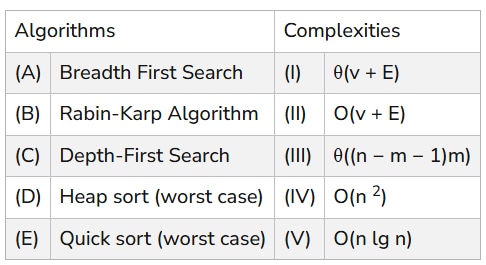
Which one of the following is the correct matching?
Answer: C. (A)-(II), (B)-(III), (C)-(I), (D)-(V), (E)-(IV) — ConceptEach algorithm has a characteristic worst-case asymptotic running time determined by how much work it does relative to its input. Graph traversals are…
- A.
(A)-(III), (B)-(II), (C)-(I), (D)-(IV), (E)-(V)
- B.
(A)-(II), (B)-(III), (C)-(I), (D)-(IV), (E)-(V)
- C.
(A)-(II), (B)-(III), (C)-(I), (D)-(V), (E)-(IV)
- D.
(A)-(III), (B)-(I), (C)-(II), (D)-(IV), (E)-(V)
Attempted by 260 students.
Show answer & explanation
Correct answer: C
Concept
Each algorithm has a characteristic worst-case asymptotic running time determined by how much work it does relative to its input. Graph traversals are bounded by the size of the graph (vertices + edges); string matching and comparison sorts are bounded by the input/pattern sizes. The key distinctions to keep straight are: BFS and DFS both touch every vertex and edge a constant number of times; a comparison sort cannot beat O(n lg n); and quick sort, unlike heap sort, can degrade on a bad pivot.
Applying it to each algorithm
Breadth First Search — visits every vertex and traverses every edge a constant number of times, so its running time is O(V + E).
Depth-First Search — like BFS, processes each vertex and edge a constant number of times, giving Θ(V + E).
Rabin–Karp Algorithm — in the worst case the rolling hash produces a match at many alignments, forcing a full character comparison of length m at each, which costs Θ((n − m − 1)m).
Heap sort (worst case) — building the heap and performing n extract-max operations, each O(lg n), gives O(n lg n) even in the worst case (it has no bad-pivot failure mode).
Quick sort (worst case) — with a consistently poor pivot (e.g. already-sorted input with first/last pivot) the partition sizes are maximally unbalanced, degrading to O(n2).
Correct mapping
Algorithm | Running time |
|---|---|
Breadth First Search | O(V + E) |
Rabin–Karp Algorithm | Θ((n − m − 1)m) |
Depth-First Search | Θ(V + E) |
Heap sort (worst case) | O(n lg n) |
Quick sort (worst case) | O(n2) |
Cross-check
The two graph algorithms take the two graph bounds (V + E), the single string-matching algorithm takes the only quadratic-in-(n,m) bound, and the two comparison sorts split between O(n lg n) and O(n2) — heap sort is guaranteed O(n lg n) while quick sort alone has a quadratic worst case. This consistent assignment matches exactly one of the offered options.
A video solution is available for this question — log in and enroll to watch it.