Consider the undirected graph below: Using Prim’s algorithm to construct a…
2020
Consider the undirected graph below:
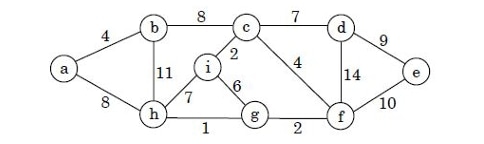
Using Prim’s algorithm to construct a minimum spanning tree starting with node 𝑎, which one of the following sequences of edges represents a possible order in which the edges would be added to construct the minimum spanning tree?
Answer: A. (a,b), (a,h), (g,h), (f,g), (c,f), (c,i), (c,d), (d,e); C. (a,b), (b,c), (c,i), (c,f), (f,g), (g,h), (c,d), (d,e) — Answer: (a,b), (a,h), (g,h), (f,g), (c,f), (c,i), (c,d), (d,e) Reasoning (step-by-step using Prim’s algorithm starting from node a): Step 1: Start at a.…
- A.
(a,b), (a,h), (g,h), (f,g), (c,f), (c,i), (c,d), (d,e)
- B.
(a,b), (b,h), (g,h), (g,i), (c,i), (c,f), (c,d), (d,e)
- C.
(a,b), (b,c), (c,i), (c,f), (f,g), (g,h), (c,d), (d,e)
- D.
(a,b), (g,h), (g,f), (c,f), (c,i), (f,e), (b,c), (d,e)
Attempted by 107 students.
Show answer & explanation
Correct answer: A, C
Answer: (a,b), (a,h), (g,h), (f,g), (c,f), (c,i), (c,d), (d,e)
Reasoning (step-by-step using Prim’s algorithm starting from node a):
Step 1: Start at a. Available edges from a are (a,b)=4 and (a,h)=8. Choose (a,b) because it has the smaller weight (4).
Step 2: Tree = {a,b}. Crossing edges are (a,h)=8, (b,c)=8 and (b,h)=11. The smallest crossing edges have weight 8; choosing (a,h) (as in the given sequence) is a valid tie-break, so add (a,h).
Step 3: Tree = {a,b,h}. The smallest crossing edge is (g,h)=1, so add (g,h).
Step 4: Tree now includes g. The smallest crossing edge is (f,g)=2, so add (f,g).
Step 5: With f added, the cheapest way to bring c into the tree is (c,f)=4 (other crossing edges are heavier), so add (c,f).
Step 6: Now that c is in the tree, (c,i)=2 is the smallest crossing edge incident on the tree, so add (c,i).
Step 7: Next the smallest remaining crossing edge to connect new vertices is (c,d)=7, so add (c,d).
Step 8: The only remaining vertex (e) is connected via (d,e)=9, so add (d,e). The tree is now a minimum spanning tree.
Why the other sequences are rejected (concise):
The sequence that picks (b,h) as the second edge is invalid because after (a,b) there exists a lighter crossing edge of weight 8 ((a,h) or (b,c)), so selecting the heavier (b,h) (weight 11) violates Prim’s greedy choice.
Any sequence that tries to add an edge connecting two vertices that are both outside the current tree (for example adding (g,h) when neither g nor h is yet in the tree) is impossible under Prim, because each chosen edge must connect the current tree to a new vertex.
Ties between equal-weight crossing edges can lead to different valid orders; the given accepted sequence assumes a particular tie-breaking. The chosen answer is consistent with breaking the tie in favor of (a,h) at the second step and thereafter always picking the minimum crossing edge.
A video solution is available for this question — log in and enroll to watch it.