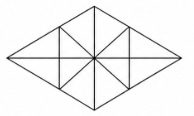
How many triangles are there in the following figure?
20172017
How many triangles are there in the following figure?
- A.
12
- B.
20
- C.
24
- D.
28
Attempted by 83 students.
Show answer & explanation
Correct answer: D
To count every triangle in a compound figure, do not just spot the obvious ones — first find every “basic” triangle, i.e. a triangular region that is not further crossed by any other drawn line (basic triangles need not all be the same size). Then find every larger triangle formed by joining two or more adjacent basic triangles, checking that all three of its sides still lie exactly along lines that are actually drawn. Add up every category once, with no omissions or double-counting.
This figure is a rhombus with its horizontal and vertical diagonals drawn, crossing at the centre. From the centre, four more lines run out to the midpoint of each of the four slanted outer edges, and a short vertical segment joins the two edge-midpoints on the left side, with a matching segment joining the two edge-midpoints on the right side.
Category | How it is bounded | Count |
|---|---|---|
Basic triangles (not crossed by any other line) | 8 smaller ones at each edge-midpoint junction, plus 4 larger ones stretching from the centre to a sharp left/right corner along the other main diagonal | 12 |
Two basic triangles joined together | Formed by combining two adjacent basic triangles across a shared spoke, a shared edge-midpoint, or the short vertical joining segment | 8 |
Quarter-figure triangles | One complete outer edge together with the two half-diagonals meeting at the centre (equal to 3 basic triangles) | 4 |
Half-figure triangles | Two complete outer edges together with one complete main diagonal (equal to 6 basic triangles — one entire half of the figure) | 4 |
Adding every category: 12 + 8 + 4 + 4 = 28 triangles in total.
Cross-check using a different grouping: split the 28 triangles into three groups — those that involve any of the extra construction points on the left side (the two left edge-midpoints and their meeting point on the horizontal diagonal), those that involve the corresponding points on the right side, and those that use only the four rhombus corners and the centre. By the figure's left-right symmetry the first two groups must be equal in size; a direct recount gives 10 in the left group, 10 in the right group, and 8 in the last group (the quarter-figure and half-figure triangles built only from the outer edges and the two main diagonals). 10 + 10 + 8 = 28, confirming the count found above.