A black and a red dice are rolled. Find the conditional probability of…
2023
A black and a red dice are rolled. Find the conditional probability of obtaining the sum 8, given that the red die resulted in a number less than 4.
Answer: A. 1/9 — Concept: For events A and B in a finite equally-likely sample space, the conditional probability of A given B is P(A|B) = n(A ∩ B) / n(B) — the count of…
- A.
1/9
- B.
4/9
- C.
5/9
- D.
7/9
Attempted by 15 students.
Show answer & explanation
Correct answer: A
Concept: For events A and B in a finite equally-likely sample space, the conditional probability of A given B is P(A|B) = n(A ∩ B) / n(B) — the count of outcomes satisfying both A and B, divided by the count of outcomes satisfying B alone. Restricting to B changes the effective sample space; only outcomes inside B are eligible for the count of A.
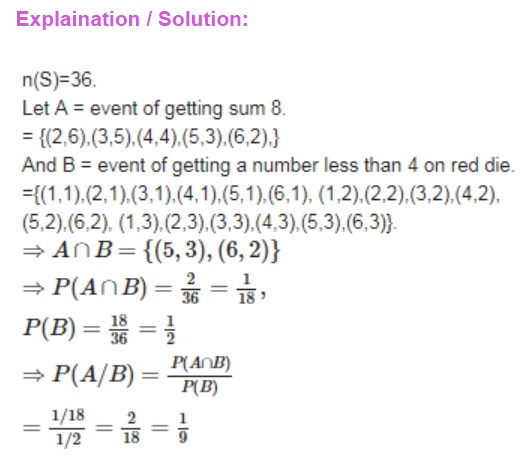
Let B be the event "the red die shows a number less than 4" — so B restricts the red die to {1, 2, 3}, while the black die still ranges freely over {1, ..., 6}. This gives n(B) = 3 × 6 = 18 equally likely outcomes.
Let A be the event "the two dice sum to 8". Within the restricted space B, check each possible red value: red = 1 needs black = 7 (impossible, no such face); red = 2 needs black = 6 (valid); red = 3 needs black = 5 (valid).
So n(A ∩ B) = 2 — exactly the outcomes (red = 2, black = 6) and (red = 3, black = 5).
Apply the conditional-probability formula: P(A|B) = n(A ∩ B) / n(B) = 2/18 = 1/9.
Cross-check using unconditional probabilities: P(B) = 3/6 = 1/2 (red less than 4), and P(A ∩ B) = 2/36 = 1/18 (only two of the 36 equally likely red-black pairs both sum to 8 and have red less than 4). Then P(A|B) = P(A ∩ B)/P(B) = (1/18)/(1/2) = 1/9, matching the direct count.
Hence the conditional probability of obtaining a sum of 8, given that the red die shows a number less than 4, is 1/9.