If all the letters of the word “WAITING” are arranged in every possible way…
2024
If all the letters of the word “WAITING” are arranged in every possible way and listed in dictionary (alphabetical) order, what will be the 32nd word in that list?
Answer: B. AGNTIWI — Concept: To find which arrangement occupies a given rank when all letters of a word are listed in dictionary (alphabetical) order, fix the letters one…
- A.
AGNTWII
- B.
AGNTIWI
- C.
AGNTIIW
- D.
AGNIITW
Attempted by 5 students.
Show answer & explanation
Correct answer: B
Concept: To find which arrangement occupies a given rank when all letters of a word are listed in dictionary (alphabetical) order, fix the letters one position at a time from left to right. At each position, count how many arrangements of the remaining letters — using n!/(repetition!) for any repeated letters — are completed by every letter that is alphabetically smaller than the one actually chosen there. Adding one to the running total of all such counts gives the exact rank of the chosen arrangement, and the same block-counting can be run forward to identify the arrangement sitting at a specific target rank.
Application:
WAITING has 7 letters — A, G, I, I, N, T, W — with I repeated twice, so arranged alphabetically the letter pool is A, G, I, I, N, T, W and the total number of distinct arrangements is 7!/2! = 2520.
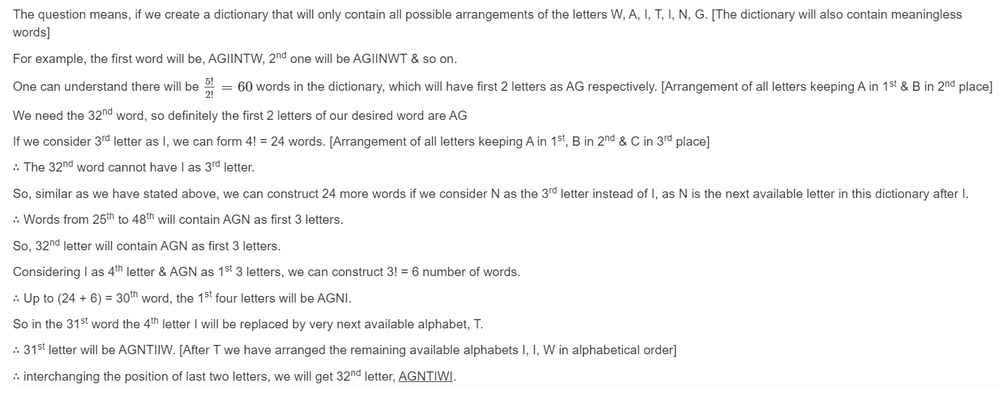
Fixing the 1st letter as A leaves G, I, I, N, T, W (6 letters, I twice) to arrange in 6!/2! = 360 ways; since 32 ≤ 360, the target word begins with A.
Fixing the 2nd letter as G leaves I, I, N, T, W (5 letters, I twice) to arrange in 5!/2! = 60 ways; since 32 ≤ 60, the target word begins with AG.
For the 3rd letter, trying I first leaves I, N, T, W (4 distinct letters), giving 4! = 24 arrangements — covering the first 24 words with prefix AGI. Since 32 exceeds 24, these are skipped and 32 − 24 = 8 carries forward.
Trying N next leaves I, I, T, W (4 letters, I twice), giving 4!/2! = 12 arrangements with prefix AGN. Since 8 ≤ 12, the 3rd letter is N, and the 8th word with prefix AGN is now needed.
For the 4th letter, trying I first leaves I, T, W (3 distinct letters), giving 3! = 6 arrangements with prefix AGNI. Since 8 exceeds 6, these are skipped and 8 − 6 = 2 carries forward.
Trying T next leaves I, I, W (3 letters, I twice), giving 3!/2! = 3 arrangements with prefix AGNT. Since 2 ≤ 3, the 4th letter is T, and the 2nd word with prefix AGNT is now needed.
The three arrangements of the remaining letters I, I, W in alphabetical order are IIW, IWI, and WII — corresponding respectively to the 1st, 2nd, and 3rd word of the AGNT-prefixed block. The 2nd word of this block is IWI.
Combining every fixed letter in order — A, G, N, T, then I, W, I — gives the 32nd word as AGNTIWI.
Cross-check: Computing the rank of AGNTIWI directly from scratch confirms this: summing, position by position, the arrangements of the remaining pool completed by every alphabetically-smaller letter at each position (0 for A, 0 for G, 24 for N ahead of the smaller I, 6 for T ahead of the smaller I, 0 for I, 1 for W ahead of the smaller I, 0 for the final I) gives 0+0+24+6+0+1+0 = 31, and adding 1 for the arrangement itself gives rank 32 — matching the word count from the forward method exactly.