Three partners A, B and C invested a total of Rs. 1,50,000. After one year, A,…
2026
Three partners A, B and C invested a total of Rs. 1,50,000. After one year, A, B and C received profits of Rs. 6,000, Rs. 10,000 and Rs. 14,000 respectively. How much amount did B invest?
Answer: D. Rs 50,000 — Concept: When partners invest for the same time period, the profit each partner receives is shared in exact proportion to the capital each has invested —…
- A.
Rs 10,000
- B.
Rs 40,000
- C.
Rs 20,000
- D.
Rs 50,000
Attempted by 1 students.
Show answer & explanation
Correct answer: D
Concept: When partners invest for the same time period, the profit each partner receives is shared in exact proportion to the capital each has invested — profit ratio = investment ratio. So if the profit shares are known, the actual investment amounts can be found by reducing the profits to their simplest ratio and then scaling that ratio to the given total investment.
Application:
Total profit = Rs 6,000 + Rs 10,000 + Rs 14,000 = Rs 30,000.
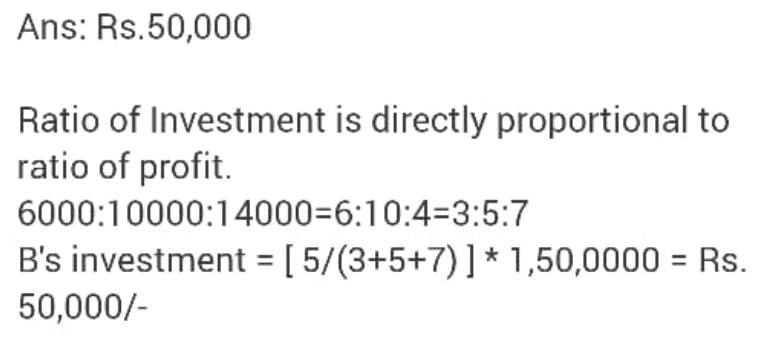
Profit ratio = 6,000 : 10,000 : 14,000 = 3 : 5 : 7 (dividing each term by their HCF, 2,000).
Since the time period is the same for all three partners, the investment ratio is also 3 : 5 : 7, giving 3 + 5 + 7 = 15 total parts.
Total investment = Rs 1,50,000, so the value of 1 part = Rs 1,50,000 ÷ 15 = Rs 10,000.
B's profit (Rs 10,000) is the middle figure, corresponding to 5 parts of the ratio, so B invested 5 × Rs 10,000 = Rs 50,000.
Cross-check:
The three investments are Rs 30,000 (3 parts), Rs 50,000 (5 parts) and Rs 70,000 (7 parts); these add up to Rs 30,000 + Rs 50,000 + Rs 70,000 = Rs 1,50,000, matching the given total, and their ratio 30,000 : 50,000 : 70,000 = 3 : 5 : 7 reproduces the original profit ratio, confirming the answer.