A cube of side 6 cm has been cut into 64 smaller but identical cubes. If it…
2023
A cube of side 6 cm has been cut into 64 smaller but identical cubes. If it was estimated that it would take 4 litres of paint to paint all the faces of the original cube, then how much paint is required to paint all the faces of all the smaller cubes?
- A.
16 litres
- B.
12 litres
- C.
20 litres
- D.
4 litres
Show answer & explanation
Correct answer: A
Concept: When a cube is divided into n = k3 identical smaller cubes, each edge of the cube is cut into k equal parts. Assuming a uniform coat of paint, the amount of paint needed is proportional to the total surface area exposed — cutting the cube into k parts per edge multiplies the total surface area, and hence the paint required, by a factor of k, even though the total volume stays the same.
Application:
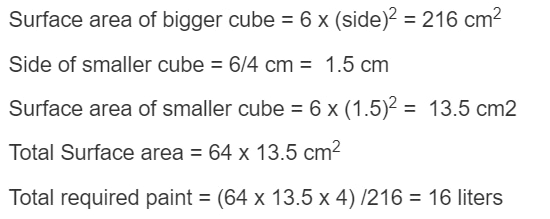
The cube is cut into 64 = 43 identical smaller cubes, so each edge is divided into k = 4 equal parts; the smaller cube's side is 6 ÷ 4 = 1.5 cm.
Surface area of the original cube = 6 × (side)2 = 6 × 62 = 216 cm2.
Surface area of one smaller cube = 6 × (1.5)2 = 13.5 cm2; total surface area of all 64 smaller cubes = 64 × 13.5 = 864 cm2.
Ratio of total surface areas = 864 ÷ 216 = 4, matching the scale factor k = 4 found in step 1.
Since the paint required is proportional to the surface area, the paint needed for all the smaller cubes = 4 litres × 4 = 16 litres.
Cross-check: The shortcut ratio equals k = ∛64 = 4 directly, so the paint required = 4 × 4 = 16 litres — the same result as the detailed surface-area computation above.