The net shown as figure (X) is folded to form a cube. From the alternatives…
2026
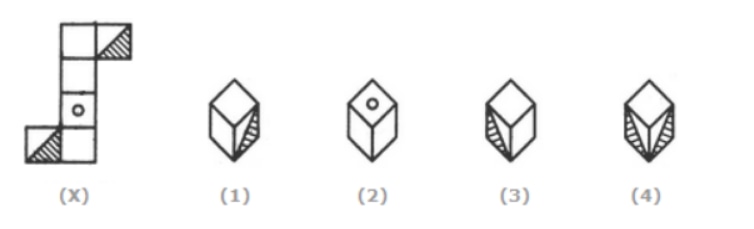
The net shown as figure (X) is folded to form a cube. From the alternatives (1), (2), (3), and (4), select the pair of boxes that can be formed from this net.
Answer: A. 1 and 3 only. — Concept When a cube net is folded, faces joined through the four-face belt acquire fixed adjacency and opposite-face relationships. Rotating the finished cube…
- A.
1 and 3 only.
- B.
1 and 4 only
- C.
2 and 4 only
- D.
3 and 4 only
Attempted by 649 students.
Show answer & explanation
Correct answer: A
Concept
When a cube net is folded, faces joined through the four-face belt acquire fixed adjacency and opposite-face relationships. Rotating the finished cube changes the view, but it never changes which faces are opposite or which three faces can meet at one vertex.
Application
Label the four faces in the vertical strip from top to bottom as A, B, C, and D. Face C carries the circle; the two side attachments are the half-shaded faces E and F.
Folding the vertical strip around the cube makes A opposite C and B opposite D. Folding the two side attachments closes the cube and makes E opposite F.
In drawing 2, the circled face meets two blank faces at one vertex. Those two available blank faces are B and D, which are opposite, so that vertex cannot occur.
In drawing 4, both half-shaded faces meet along an edge. Faces E and F are opposite, so they cannot share an edge.
Drawings 1 and 3 preserve the opposite-face pairs and differ only by a valid rotation of the cube.
Cross-check
Each visible cube corner must contain one face from each opposite pair: one of A/C, one of B/D, and one of E/F. Drawings 1 and 3 satisfy this rule, whereas drawings 2 and 4 place an opposite pair at the same corner.
Therefore, the boxes shown in drawings 1 and 3 can be formed from the net.