In each of the following questions, you are given a figure (X) followed by…
2023
In each of the following questions, you are given a figure (X) followed by four alternative figures (1), (2), (3) and (4) such that figure (X) is embedded in one of them.
Find out the alternative figure which contains figure (X) as its part.
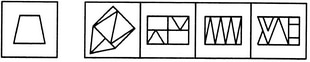
(X) (1) (2) (3) (4)
Answer: C. 3 — Concept: Embedded-figure questions hide the target figure (X) as an exact sub-shape inside one of the four answer figures — same size, same shape, same…
- A.
1
- B.
2
- C.
3
- D.
4
Attempted by 15 students.
Show answer & explanation
Correct answer: C
Concept: Embedded-figure questions hide the target figure (X) as an exact sub-shape inside one of the four answer figures — same size, same shape, same orientation, formed only by lines already present in that figure. To find it, trace figure (X)'s exact outline inside each answer figure without adding or removing any line.
Application:
Figure (X) is an isosceles trapezoid: a shorter top edge, a longer bottom edge, and two equal slanted legs joining them.
The overlapping diamond-and-kite alternative is built from oblique outlines that meet at pointed vertices. Its enclosed loops turn through those pointed vertices rather than following two horizontal boundaries joined by slanted sides.
The rectangular-grid alternative forms rectangles and triangles from horizontal, vertical, X-shaped, and V-shaped lines. Its closed loops include a vertical grid edge or a diagonal pair meeting at an interior junction.
In the horizontal zig-zag alternative, one cell uses a short upper horizontal edge, two outward-slanting sides, and a longer lower horizontal edge. Tracing those four existing segments reproduces figure (X) exactly.
The crossed-diagonal-and-bands alternative combines a vertical outer frame, crossing diagonals, and horizontal strips. Its candidate loops include a vertical frame edge, a horizontal band, or diagonals meeting at the central crossing.
Cross-check: Overlaying figure (X) on the horizontal zig-zag alternative, as shown in the diagram, places its four-edge outline exactly on one zig-zag cell, confirming that this visual pattern contains the target.

Answer value: 3 — the horizontal zig-zag alternative