Directions (1 to 3): A commercial flower grower raises flowers in each of the…
2023
Directions (1 to 3): A commercial flower grower raises flowers in each of the three growing seasons every year-spring, summer, and winter-with the year beginning in spring. Exactly seven different kinds of flowers- A, B, C, D, E, F, and G-are grown every year. Each kind of flower is grown at least once a year. The flowers are grown according to the following rules: B can be grown in a growing season only if A is grown in the preceding season. No more than three different kinds of flowers are grown in any one growing season. No kind of flower can be grown in two seasons in a row. A can be grown neither in the winter season nor in the same growing season as E or F. C and D are always grown in the same growing season. If G and B alone are grown in the winter season, then which of the following must be grown in the preceding spring?
Answer: D. E — Concept: In a constraint-based scheduling puzzle, first convert each conditional rule into what it forces for the season named in the question, then use the…
- A.
A
- B.
B
- C.
D
- D.
E
Attempted by 7 students.
Show answer & explanation
Correct answer: D
Concept: In a constraint-based scheduling puzzle, first convert each conditional rule into what it forces for the season named in the question, then use the "at least once per year" and "maximum three per season" caps to force any flower left without a home into whichever season remains — that forced placement is what "must be true" means here.
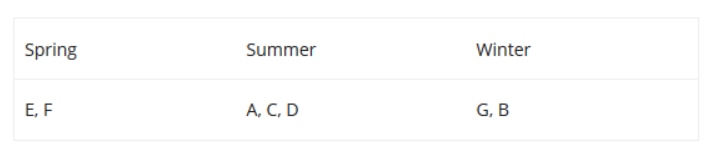
Winter is fixed as G, B only (given).
The rule 'B needs A in the immediately preceding season' forces A into Summer, since Summer immediately precedes Winter.
The rule 'A cannot share a season with E or F' then excludes both E and F from Summer; they are also excluded from Winter (already closed with G, B). Since every flower is grown at least once a year, Spring is the only season left for E and F, so both must be grown there.
C and D are always grown together and cannot go in Winter (closed). Placing them in Spring would put four flowers (E, F, C, D) in one season, breaking the 'no more than three per season' rule, so C and D must be grown in Summer together with A, filling Summer to its cap of three.
This forces the required placements: Spring must contain E and F, and Summer must contain A, C and D, alongside the given Winter = G, B. (Whether G additionally repeats in Spring is not fixed by the remaining rules, but that does not change what Spring must contain.)
Checking the forced portions against all five rules confirms them: B (Winter) has A in the immediately preceding Summer; Spring (E, F) and Summer (A, C, D) each stay within the three-flower cap; no flower repeats across two consecutive seasons; A avoids Winter and avoids sharing a season with E or F; and C, D stay together — every rule holds, and all seven flowers appear at least once this year.
Result: E must be grown in the preceding spring.