Two positions of a dice are shown below. When 3 points are at the bottom, how…
202420242024
Two positions of a dice are shown below. When 3 points are at the bottom, how many points will be at the top?
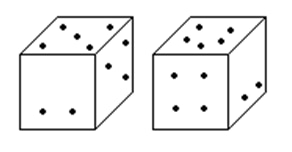
Answer: C. 4 — Key idea: on any die, the three opposite pairs are Top–Bottom, Front–Back, and Left–Right — this pairing never changes no matter how the die is turned. When…
- A.
2
- B.
5
- C.
4
- D.
6
Attempted by 379 students.
Show answer & explanation
Correct answer: C
Key idea: on any die, the three opposite pairs are Top–Bottom, Front–Back, and Left–Right — this pairing never changes no matter how the die is turned. When two pictures show the same die in two positions, matching a face that keeps the same picture-position in both (here, the top face) tells you the die was only spun about the axis through that face; the remaining faces then keep a fixed round-the-die order, which lets you read off which value sits opposite which.
In the first picture the visible faces read: top = 5, front = 2, side (right) = 3. In the second picture the visible faces read: top = 5, front = 4, side (right) = 2.
The top face reads 5 in both pictures, so the die has only been spun about the vertical axis through that top face — the front and side faces trade places, but their round-the-die order stays fixed.
Between the two pictures, the value 2 moves from the front position to the side (right) position. Following that same spin through, the face that was on the side (right) position moves to the back, and the face that was on the far (left) position moves forward onto the front — so the hidden far (left) face must be the value now seen on the front of the second picture, which is 4.
The side (right) face and the far (left) face of a die are always directly opposite each other. Here the side (right) face reads 3 and the far (left) face works out to 4, so 3 and 4 are the opposite pair.
Top and bottom are also always opposite each other, so whenever 3 is at the bottom, its fixed opposite — 4 — must be at the top.
Cross-check: this does not rely on the common “opposite faces add to 7” shortcut, and that shortcut is not reliable for this particular die anyway — in the first picture the top (5) and front (2) faces appear together, so 5 and 2 are adjacent, not opposite, even though 5 + 2 = 7. The 3–4 opposite pair found above comes only from matching the two given pictures, and it happens to add to 7 purely by coincidence, not because every pair on this die does.
So, when 3 points are at the bottom, 4 points are at the top.