The sum of three from the four numbers A, B, C, D are 3797, 3484, 3321 and…
2024
The sum of three from the four numbers A, B, C, D are 3797, 3484, 3321 and 3657. What is the largest of the numbers A, B, C, D?
Answer: D. 1432 — Concept: When several sums are given, each formed by leaving out exactly one number from a set of n numbers, adding all of these given sums counts every…
- A.
1678
- B.
1544
- C.
1568
- D.
1432
Show answer & explanation
Correct answer: D
Concept: When several sums are given, each formed by leaving out exactly one number from a set of n numbers, adding all of these given sums counts every individual number (n-1) times, since each number is excluded from only one sum. So the total of all n numbers equals (sum of the given sums) divided by (n-1); once the total is known, each individual number equals the total minus the sum that excluded it.
Application:
Let T = A + B + C + D, the total of all four numbers.
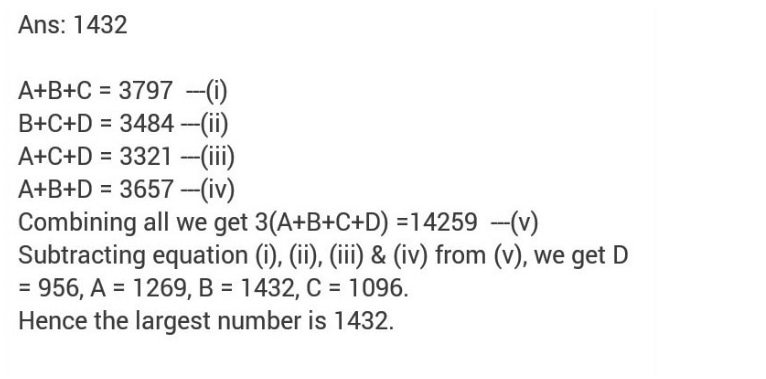
Add the four given three-number sums: 3797 + 3484 + 3321 + 3657 = 14259.
Since each of A, B, C and D is included in exactly 3 of these 4 sums (and excluded from only 1), 14259 = 3T, so T = 14259 / 3 = 4753.
Each individual number equals T minus the given sum that excluded it: 4753 - 3797 = 956; 4753 - 3484 = 1269; 4753 - 3321 = 1432; 4753 - 3657 = 1096.
These four results, {956, 1269, 1432, 1096}, are A, B, C and D in some order; comparing them shows 1432 is the largest.
Cross-check: Adding the four derived individual values back together, 956 + 1269 + 1432 + 1096 = 4753, which matches the total T found above - confirming the working is consistent.
Result: The largest of the four numbers is 1432.