If the sum of n terms of an AP is 300, the first term is 10, and the last term…
20252024202520232025
If the sum of n terms of an AP is 300, the first term is 10, and the last term is 50, then n is equal to?
Answer: D. 10 — Concept: For an arithmetic progression (AP), the sum of n terms can be written using the first term and the last term as Sn = n/2 (a + l), where a is the…
- A.
6
- B.
8
- C.
9
- D.
10
Show answer & explanation
Correct answer: D
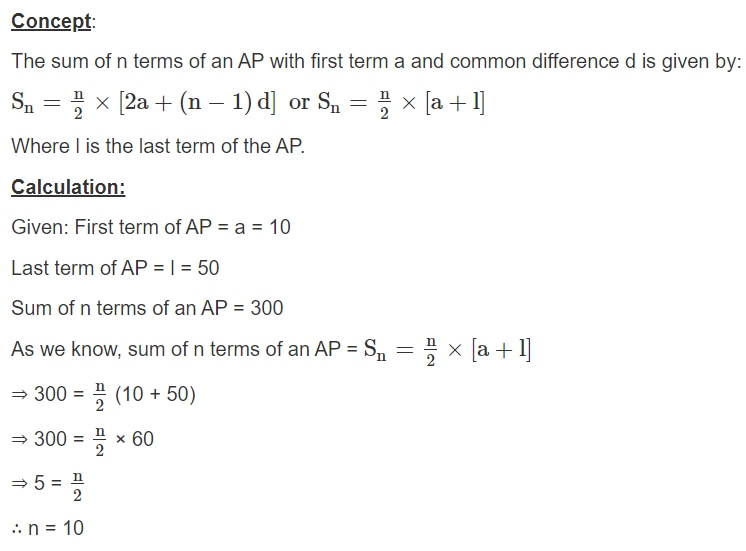
Concept: For an arithmetic progression (AP), the sum of n terms can be written using the first term and the last term as Sn = n/2 (a + l), where a is the first term, l is the last term, and n is the number of terms.
Application:
Given: sum of n terms Sn = 300, first term a = 10, last term l = 50.
Substitute into Sn = n/2 (a + l): 300 = n/2 (10 + 50).
Simplify inside the bracket: 300 = n/2 × 60.
Divide both sides by 30 to isolate n: n = 300 / 30 = 10.
Cross-check: Substituting n = 10 back gives S10 = 10/2 (10 + 50) = 5 × 60 = 300, which matches the given sum, confirming n = 10.