A train, running at (3/7)th of its own speed, reached the destination in 14…
2024
A train, running at (3/7)th of its own speed, reached the destination in 14 hours. How much time could have been saved if the train had run at its own (full) speed?
Answer: B. 8 — ConceptFor a fixed distance, speed and time are inversely proportional: Speed × Time = Distance (constant). So if speed changes by some ratio, time changes by…
- A.
6
- B.
8
- C.
11
- D.
10
Attempted by 1 students.
Show answer & explanation
Correct answer: B
Concept
For a fixed distance, speed and time are inversely proportional: Speed × Time = Distance (constant). So if speed changes by some ratio, time changes by the reciprocal ratio.
Application
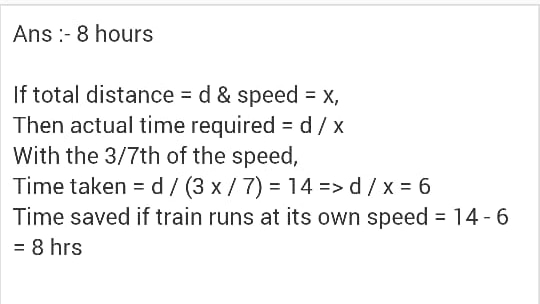
The train's slower speed is (3/7) of its usual speed, so slower speed : usual speed = 3 : 7.
Since time is inversely proportional to speed, time at slower speed : usual time = 7 : 3 (the ratio flips).
The time at slower speed corresponds to 7 units and equals the given 14 hours, so 1 unit = 14 ÷ 7 = 2 hours.
The usual (full-speed) time is 3 units = 3 × 2 = 6 hours.
Time saved = time at slower speed − usual time = 14 − 6 = 8 hours.
Cross-check
At the slower speed (3/7 of usual), time taken = usual time × (7/3) = 6 × 7/3 = 14 hours — this matches the given data, confirming the usual time of 6 hours and a saving of 8 hours.