A boat covers 40 km upstream and 90 km downstream in 5 hr. It can also cover…
2023
A boat covers 40 km upstream and 90 km downstream in 5 hr. It can also cover 60 km upstream and 60 km downstream in 5 hr. The speed of the water current is
- A.
3 km/hr
- B.
5 km/hr
- C.
4 km/hr
- D.
2 km/hr
Attempted by 1 students.
Show answer & explanation
Correct answer: B
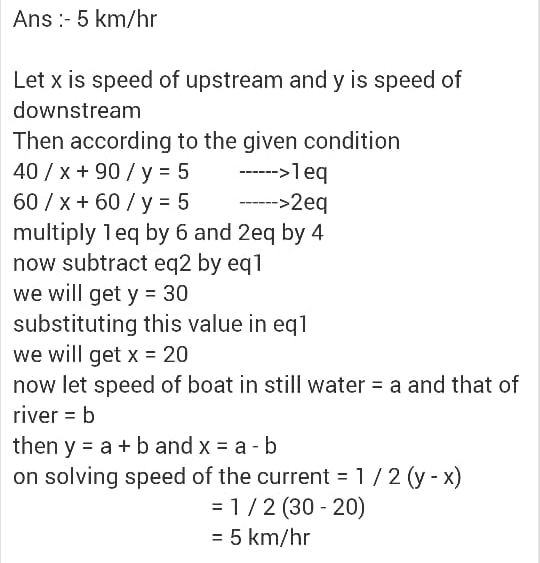
For boats-and-streams problems, downstream speed equals the boat's still-water speed plus the current speed, and upstream speed equals the boat's still-water speed minus the current speed, so the current speed itself equals half the difference between the downstream and upstream speeds. When a problem gives two different distance combinations that each take the same total time, treat the reciprocals of the upstream and downstream speeds, i.e. the time taken per km, as the two unknowns and solve the resulting pair of linear equations before computing the actual speeds.
Let p = 1/(upstream speed) and q = 1/(downstream speed), that is, the time taken to cover 1 km upstream and 1 km downstream respectively.
The first trip, 40 km upstream and 90 km downstream in 5 hr, gives the equation 40p + 90q = 5.
The second trip, 60 km upstream and 60 km downstream in 5 hr, gives 60p + 60q = 5, which simplifies to p + q = 1/12.
Substituting p = 1/12 minus q into the first equation: 40(1/12 minus q) + 90q = 5, which simplifies to 10/3 + 50q = 5, so 50q = 5/3 and q = 1/30.
From p + q = 1/12, p = 1/12 minus 1/30 = 5/60 minus 2/60 = 3/60 = 1/20.
So the downstream speed is 1/q = 30 km/hr and the upstream speed is 1/p = 20 km/hr.
The current speed is half the difference between the downstream and upstream speeds: (30 minus 20)/2 = 5 km/hr. Checking against both original equations confirms it: 40/20 + 90/30 = 2 + 3 = 5 hr, and 60/20 + 60/30 = 3 + 2 = 5 hr, both matching the given times.