Difference between simple interest and compound interest on Rs. 1200 for 1…
2023
Difference between simple interest and compound interest on Rs. 1200 for 1 year at 10% per annum considered half-yearly is
Answer: A. Rs. 3 — Concept: For a principal P at annual rate R% over time T years, simple interest is SI = P × R × T / 100. When interest is compounded half-yearly, each…
- A.
Rs. 3
- B.
Rs. 5
- C.
Rs. 9
- D.
Rs. 6
Attempted by 3 students.
Show answer & explanation
Correct answer: A
Concept: For a principal P at annual rate R% over time T years, simple interest is SI = P × R × T / 100. When interest is compounded half-yearly, each half-year period earns interest at the half-yearly rate i = R/2 percent, applied to the running balance, so the amount after k half-year periods is A = P × (1 + i/100)^k and CI = A − P. One year contains exactly 2 half-year periods.
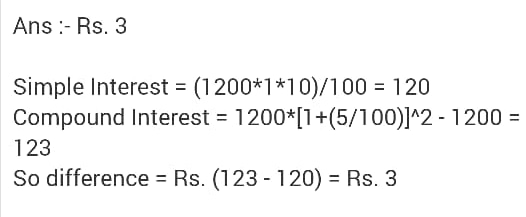
Simple interest: SI = 1200 × 10 × 1 / 100 = Rs. 120.
Half-yearly rate = 10% / 2 = 5% per half-year, applied over 2 half-year periods in one year.
Amount after compounding: A = 1200 × (1 + 5/100)² = 1200 × 1.05² = 1200 × 1.1025 = Rs. 1323.
Compound interest: CI = A − P = 1323 − 1200 = Rs. 123.
Difference: CI − SI = 123 − 120 = Rs. 3.
Cross-check: the direct shortcut for the CI–SI gap over one year compounded half-yearly is Difference = P × i², where i is the half-yearly rate as a fraction (i = 0.05 here). This gives 1200 × 0.05² = 1200 × 0.0025 = Rs. 3, confirming the result.
Hence, the difference between the compound interest and the simple interest is Rs. 3.