In an examination having 2 subjects, 70% of students passed in physics, 65%…
2025
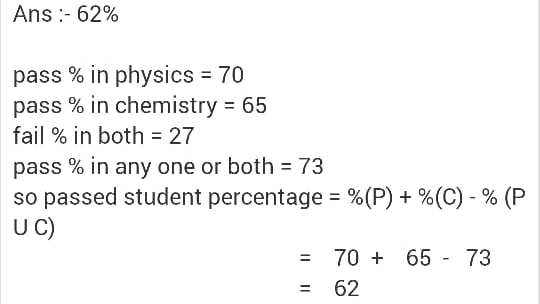
In an examination having 2 subjects, 70% of students passed in physics, 65% passed in chemistry and 27% failed in both subjects. The percentage of students who passed in both Physics and Chemistry is
Answer: A. 62% — For two overlapping groups, the inclusion-exclusion principle gives the percentage in "A or B (or both)" as percentage(A) + percentage(B) minus…
- A.
62%
- B.
66%
- C.
69%
- D.
None of these
Attempted by 2 students.
Show answer & explanation
Correct answer: A
For two overlapping groups, the inclusion-exclusion principle gives the percentage in "A or B (or both)" as percentage(A) + percentage(B) minus percentage(both). Equivalently, once the percentage failing both is known, the percentage passing at least one subject is 100% minus that both-failed percentage.
27% of students failed both subjects, so the percentage who passed at least one subject = 100% − 27% = 73%.
Let P = 70% (passed physics) and C = 65% (passed chemistry). By inclusion-exclusion, percentage who passed both = P + C − (percentage who passed at least one) = 70% + 65% − 73%.
Percentage who passed both subjects = 62%.
Cross-check: the intersection (62%) does not exceed either individual pass rate (65% and 70%), and adding it to the percentage who did not pass both subjects (100% minus 62% = 38%) accounts for the full student population.