A bag contains 3 white balls and 2 black balls. Another bag contains 2 white…
2024
A bag contains 3 white balls and 2 black balls. Another bag contains 2 white and 4 black balls. A bag and a ball are picked at random. The probability that the ball will be white is
Answer: D. 7/15 — Concept: Law of Total Probability When an item is drawn in two stages — first a bag is chosen at random, then a ball is drawn from that bag — the overall…
- A.
7/11
- B.
7/19
- C.
7/14
- D.
7/15
Attempted by 5 students.
Show answer & explanation
Correct answer: D
Concept: Law of Total Probability
When an item is drawn in two stages — first a bag is chosen at random, then a ball is drawn from that bag — the overall probability of an outcome is the weighted sum of its probability under each bag, weighted by the chance of picking that bag: P(white) = P(Bag A)·P(white | Bag A) + P(Bag B)·P(white | Bag B).
Application
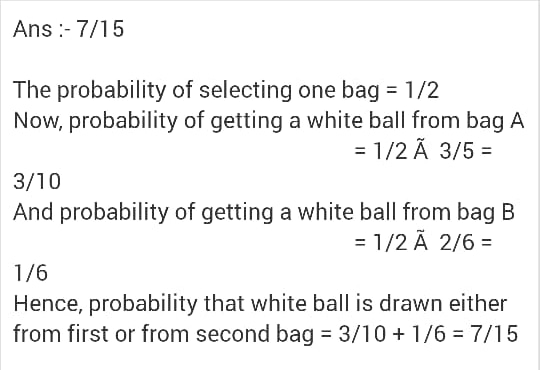
Bag A has 3 white and 2 black balls (5 total), so P(white | Bag A) = 3/5.
Bag B has 2 white and 4 black balls (6 total), so P(white | Bag B) = 2/6 = 1/3.
Each bag is equally likely to be picked, so P(Bag A) = P(Bag B) = 1/2.
By the law of total probability: P(white) = (1/2)(3/5) + (1/2)(2/6).
Over a common denominator of 30: (1/2)(3/5) = 9/30 and (1/2)(2/6) = 5/30.
Adding: 9/30 + 5/30 = 14/30 = 7/15.
Cross-check
P(black | Bag A) = 2/5 and P(black | Bag B) = 4/6 = 2/3, so P(black) = (1/2)(2/5) + (1/2)(2/3) = 1/5 + 1/3 = 3/15 + 5/15 = 8/15. Since P(white) + P(black) = 7/15 + 8/15 = 1, the result checks out.